At the beginning of 2020, when the spread of SARS-CoV-2 was undeniable but its consequences were still unknown, some tried to minimize the situation, saying that it was “just like a flu”.
However, the flu is not an insignificant disease: it is a viral infection of the airways that we can prevent with a vaccine produced every year based on the characteristics of the circulating strains.
Nowadays, the perception of seasonal flu outbreaks is less frightening than in the past, not because the virus is less aggressive, but because our living conditions have improved since the second half of the last century, giving us tools to contain the virus:
- Better standards of hygiene
- Availability of seasonal vaccines
- Availability of medicines and medical care for the most severe cases.
To really understand the relevance of this infection, an understanding of the characteristics of the virus is necessary.
It is an RNA virus, classified into 4 different types: A and B are responsible for the seasonal epidemics, C causes only mild symptoms, while D is not known to infect humans.
Type A virus (IAV) has several subtypes that present with different versions of the proteins haemagglutinin (H) and neuraminidase (N). These two proteins are very important from the human point of view, because they are displayed on the surface of the virus, mediate the entry and the release of new viral particles from infected cells, and can be recognized by antibodies. The virus has 10 essential proteins and several accessory proteins that are subtype-specific.
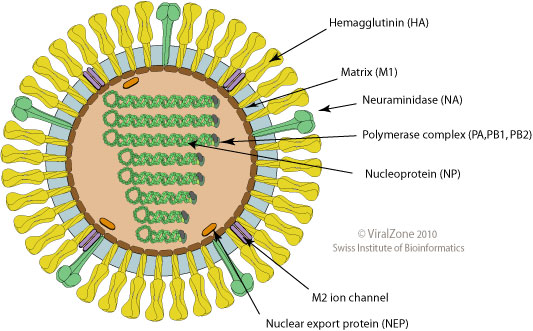
Influenza virus can rapidly mutate according to a phenomenon called antigenic drift, so that the antibodies induced by the vaccination, will not probably recognize the virus one year later. This is why, unlike other infectious diseases, one single vaccine is not enough, and yearly vaccination is recommended. Moreover, the genome of type A and B viruses consists of 8 RNA fragments, that can undergo rearrangement, increasing the variability of the viral proteins (antigenic shift); this is particularly important for protein H of IAV. No other human pathogen can evolve as quickly as Influenza virus.
Usually, several types and subtypes of Influenza virus circulate among the population at any time, and the annual vaccine normally targets two strains of type A and type B.
Aquatic birds are the natural reservoir for IAV, and it can be spread between human beings and other animals, as in the case of avian flu and swine flu (which I briefly mentioned in this post), potentially causing pandemics as a result of the host shift after rearrangement and antigenic shift. On the other hand, Influenza virus type B (IBV) only infects humans.
There were 3 IAV pandemics during the last century (1918 – “Spanish flu”, 1957/58 – “Asiatic flu”, 1968) and another one only 11 years ago, in 2009. The latter started in Mexico and was rapidly contained thanks to the prompt development of an efficient specific vaccine, nonetheless, it caused the death of about 200.000 people (mostly young or not included in the classical risk groups), highlighting that a pandemic may start at any moment in any place.
During seasonal outbreaks, 75% of infections are usually asymptomatic.
In other cases, rapid onset of symptoms is observed, including fever, cough, malaise, headache, myalgia, and runny nose. The death of infected cells weakens the airway mucosa, turning them more prone to other infections. Moreover, the inflammation caused by the virus induces cough and sneezes that expel a huge number of viral particles able to infect other people.
When a bacterial infection occurs on a flu-infected patient, the resulting disease is more severe; the most common consequence is pneumonia or fatal myocarditis and encephalitis in the most severe cases.
Like other infections of the airways, Influenza virus spreads through droplets, and it can also be transmitted by contact with contaminated objects. It is a very contagious virus that can spread rapidly from person to person. This is why basic hygiene rules are essential for prevention: wash your hands, cover your mouth when you cough or sneeze, avoid contact with symptomatic patients, and self-isolate if ill.
Seasonal flu affects about 2-5 million people every year, causing 250.000-500.000 deaths.
How is important the get vaccinated against seasonal flu in the context of the SARS-CoV-2 pandemic? Due to the current situation, getting vaccinated is more important than ever, with positive effects both for the individuals and the community:
- It limits the spread of IAV and IBV in the population, contributing to herd immunity against Influenza virus (always true, with or without SARS-CoV-2)
- It avoids double infections that can cause severe disease with still unknown consequences
- It helps the diagnosis of COVD-19: since the early symptoms are similar for both infections, being vaccinated against seasonal flu allows to rule out this possibility
- It prevents the saturation of hospitals due to severe cases of flu, ensuring beds and medical assistance for COVID-19 patients.
(To know more about how vaccines work click here)
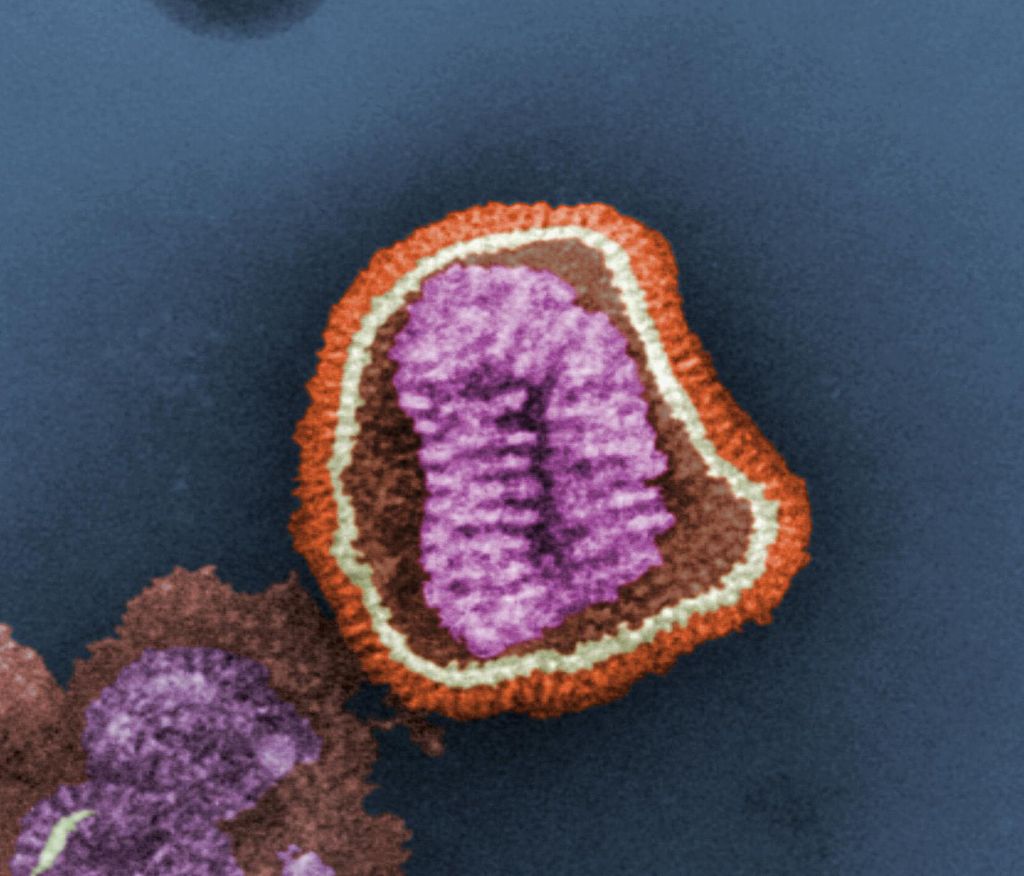
Photo Credit: Cynthia GoldsmithContent Providers(s): CDC/ Dr. Erskine. L. Palmer; Dr. M. L. Martin, Public domain, via Wikimedia Commons
Bibliography
Influenza A Virus Cell Entry, Replication, Virion Assembly and Movement,Dou D. et al., Frontiers in Immunology 2018, https://doi.org/10.3389/fimmu.2018.01581
Novel Influenza D virus: Epidemiology, pathology, evolution and biological characteristics, Shuo Su et al., Virulence 2017 https://doi.org/10.1080/21505594.2017.1365216
Two Years after Pandemic Influenza A/2009/H1N1: What Have We Learned?, Cheng V. et al., Clinical Microbiology Reviews 2012, https://doi:10.1128/CMR.05012-11
European Centre for Disease Prevention and Control: https://www.ecdc.europa.eu/en/seasonal-influenza/facts/factsheet
Centers for Disease Control and Prevention: https://www.cdc.gov/flu/pandemic-resources/index.htm
World Health Organization: https://www.who.int/influenza/en/
 Virus&Co.
One thought on “The flu: seasonal outbreaks and pandemics”