To obtain marketing authorization, all drugs must pass several phases of preclinical (in the lab) and clinical (on human volunteers) trials.
During the preclinical phases, molecules are tested on models such as cells, and animal models more or less similar to humans (from mice to primates, where permitted by the local laws). Experimentation on animal models is a complex topic that deserves a post for its own; in this post, I will discuss clinical trials only.
Once confirmed that the molecule has the desired effects on cells and animal models, it has to be tested on humans in clinical trials. Even if humans are more similar to mice than some of us are would like to admit, there are some differences that, even if most of the times are minimal (some base here and there in the sequence of a gene), may be critical.
Who authorizes and controls clinical trials? This is the task of regulatory agencies like the European Medicine Agency (EMA) in the European Union, the Food and Drug Administration (FDA) in the US, the Medicines and Healthcare products Regulatory Agency (MHRA) in the United Kingdom. Single States within the European Union have their own agency, like AIFA in Italy.
Who pays for clinical trials? Producers provide financial resources to test their own products. Clinical trials can be also supported by grants from public or private funds (foundations, patients associations, etc)
Where are clinical trials conducted and who collects and analyses data? Clinical trials are conducted in universities, research centres, and hospitals by medical doctors and by authorized scientific and healthcare staff. Personnel involved in clinical trials must have adequate and certified training.
During the design of the clinical trial, it is decided
- how many volunteers will be enrolled, with what characteristics and for how long
- what parameters must be measured in patients before and after the treatment
- what adverse effect will be tolerated
- under what condition the trials will be stopped.
All the procedure details and how and where data must be collected are described in a protocol. If data from a patient are not correctly registered, or if there is any doubt on how the procedure has been carried, the results from that patient will not be considered valid and will not be analysed with the other data. Every error or doubt must be described and will be part of the trial documentation. Protocols have to be approved by the regulatory agencies, who inspect the sites of the clinical trials to verify the accuracy of the procedures.
Phases of clinical trials
Phase I: the safety and tolerability of the new drug are assessed.
These tests are conducted on a relatively small number of healthy volunteers, who have neither the target pathology nor any other disease. The drug is tested in different doses and all the effects are registered, as well as how the drug is distributed and absorbed in the organism. Only if the adverse effects do not overcome the intended beneficial effect, agencies authorize the next phase. About 70% of the new drugs pass phase I.
Phase II: the efficacy of the new drug is tested.
This phase is carried on volunteers with the disease that the new product intends to cure. Doses that resulted to be not toxic in phase I studies are administered to different groups of patients and compared to a placebo (an inactive treatment). Volunteers do not know whether they have received the drug or the placebo to avoid any possible bias in the reported effects (adverse as well as beneficial); this procedure is called single-blind. In most cases, clinical trials are double–blind studies (the participants and the experimenters do not know which group received the placebo and which received the treatment), and sometimes they are triple-blind (who analyses the data do not know from which group they are).
At the end of this phase, which takes about 2 years, the experimenters identify the dose (or doses) with the best results and the least adverse effects. About 33% of products pass to the following phase.
Phase III: the superiority of the new drug is tested against other products already available.
This phase involves thousands of volunteers, randomly distributed in groups, receiving either the new product or another drug already approved for the same disease, or a combination of them. The aim is to assess whether the new drug is as efficient as or more efficient than the existing one, with the same or fewer adverse effects. Volunteers are monitored for 2-5 years.
If the results of the phase III study demonstrate that the efficacy and safety of the new product are at least equivalent, the producer can apply for marketing authorization. About 25-30% of drugs in phase III is successful.
Phase IV: long-term effects and very rare adverse reactions are monitored
Clinical trials involve thousands of volunteers (sometimes tens of thousands) representative of the global population. Sometimes, however, it is only during the massive use of a drug that some effects (the rarest ones) become visible. This is why medical doctors have to communicate all the adverse effects experienced by their patients, and the safety information of all drugs are continuously updated. In case that the observed adverse effects are more severe or more frequent than during the trials, regulatory agencies can suspend or withdraw marketing authorization.
Sometimes, phases can be shortened or combined, for example, when:
- a new application of an already approved product is under investigation (phase I was already conducted in the past)
- there are no authorized drugs for the same disease (phase II and phase III can be combined and conducted on a larger number of volunteers).
Vaccines undergo the same procedure, with one important difference: vaccines are administered in healthy individuals to prevent a disease and not to cure it, therefore acceptable side effects must be minimal, efficacy must be very high, and the beneficial effect must exceed any risk.
Data from clinical trials conducted in Europe are public available at www.clinicaltrialsregister.eu; those conducted in the USA can be found at clinicaltrials.gov
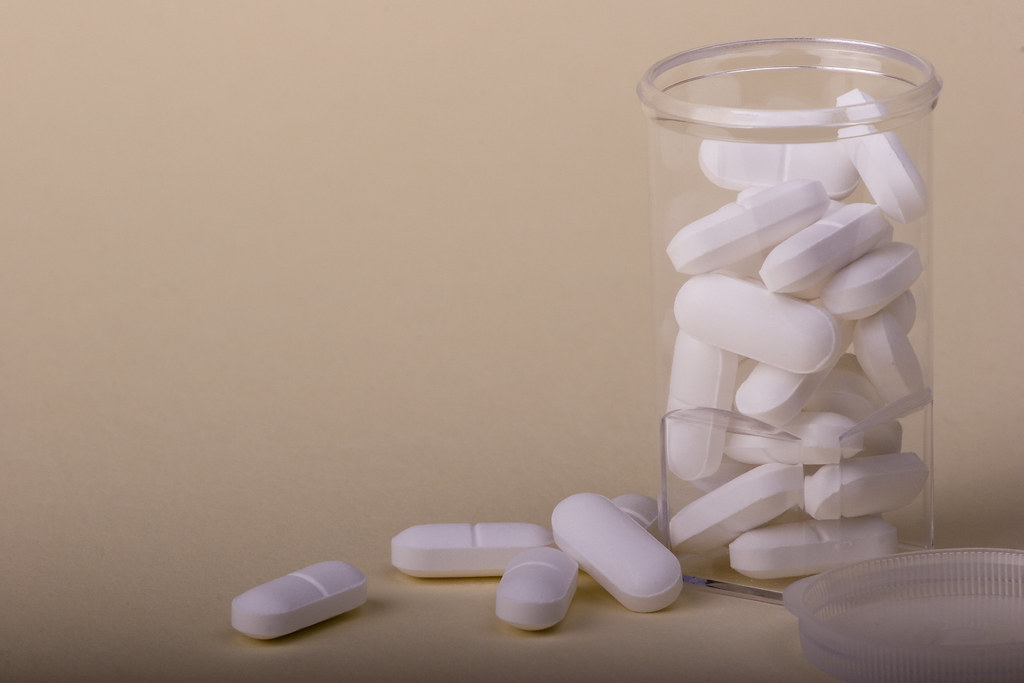
Photo: “Pills & Container (Landscape)” by Destinys Agent is licensed with CC BY-NC 2.0
Bibliography:
https://www.fda.gov/patients/drug-development-process/step-3-clinical-research
https://www.aifa.gov.it/web/guest/ricerca-e-sperimentazione-clinica
https://www.who.int/health-topics/clinical-trials/#tab=tab_1
 Virus&Co.