The recent pandemic has highlighted how humans are part of a broad system in which elements are strongly connected and on a constant search for equilibrium.
Two brilliant examples of this fragile balance are the Wuhan wet market, where live animals used to be sold and many species were in close contact, and the return of wild animals in urban settings (wild boars in Rome and deers in Paris) during the lockdown when human activity was reduced to the bare minimum. This show how closely connected the human population, the animals and also the plants are, since they share their ecosystems, especially now that the growing human population requires the production of more food, and therefore the exploitation of more natural resources.
For these reasons, integration of developmental programs, legislation and scientific research is needed to safeguard public health; this approach, which involves governments international organisations and research centers, is called “One Health”: a global health.
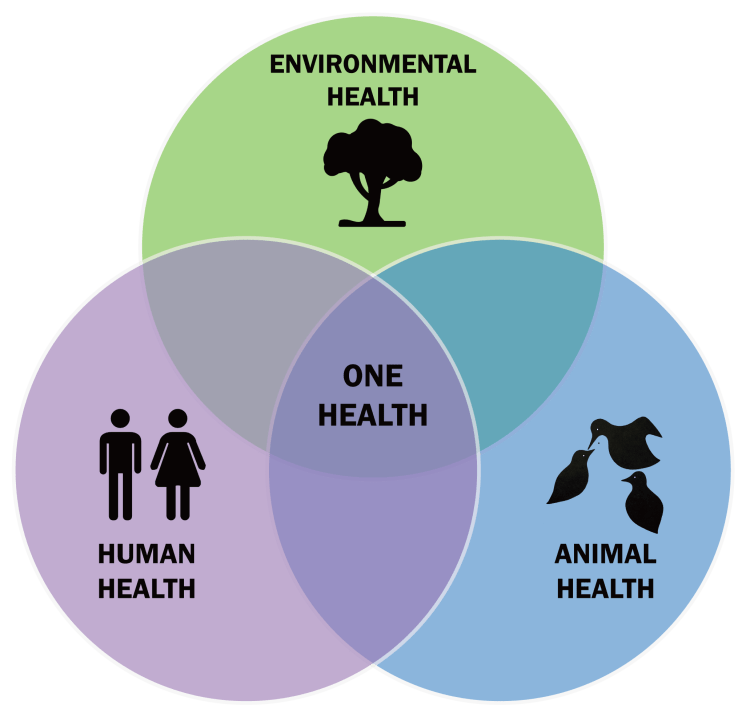
Among the organisations that promote the One Health approach, the World Health Organisation (WHO), the Food and Agriculture Organization of the United Nations(FAO), the United Nations Environment Program (UNEP), and the World Organization for Animal Health (WOAH) play strategic roles.
The main goal is to reduce the health threats at the junctions between human beings, other animal species, and the environment. Importantly, some microorganisms can infect both humans and other species, and could easily be transferred from one species to another either by direct contact or by eating contaminated food (especially in the case of antibiotic-resistant bacteria). To avoid these situations, it is essential to improve the health condition of animals on farms, and to limit the contact between wild animals, livestock and humans by limiting human activities in the natural environment.
Other fundamental aspects of the One Health approach are the conservation of biodiversity and the mitigation of climate change. Global warming, deforestation and droughts are pushing some animal species out of their usual habitat in search of more hospitable areas, increasing contact between species that until now have lived apart and, therefore, the probability of sharing microorganisms.
According to a study published on Nature, there are at least 10.000 viruses able to infect humans, but most of them are currently circulating “unseen” in wild species. The authors simulated the movements of these viruses through the terrestrial mammals based on the climate changes expected until 2070; they have found new combinations of animal species and a high probability of contact with humans, that may allow about 4000 virus transmission between species, even keeping global warming below a 2°C. All of this without taking into account viruses transmitted by birds, reptiles, amphibious animals and sea mammals!
Results like this clearly show that global warming derived from human activities is a major factor in the emergence of new zoonosis and potential pandemics.
In conclusion, to be healthy humans we need a healthy planet, and we are the ones to have to take good care of it.
Bibliography
Climate change increases cross-species viral transmission risk, Carlson, C.J. et al.. Nature 2022 https://doi.org/10.1038/s41586-022-04788-w
From SARS to COVID-19: A previously unknown SARS- related coronavirus (SARS-CoV-2) of pandemic potential infecting humans – Call for a One Health approach El Zowalaty M.E., Järhult J.D. One Health 2020 http://10.1016/j.onehlt.2020.100124
Centers for Disease Control and Prevention: https://www.cdc.gov/onehealth/basics/index.html
World Health Organization: https://www.who.int/news-room/questions-and-answers/item/one-health
Istituto Superiore di Sanità: https://www.iss.it/one-health (Italian only)
 Virus&Co.