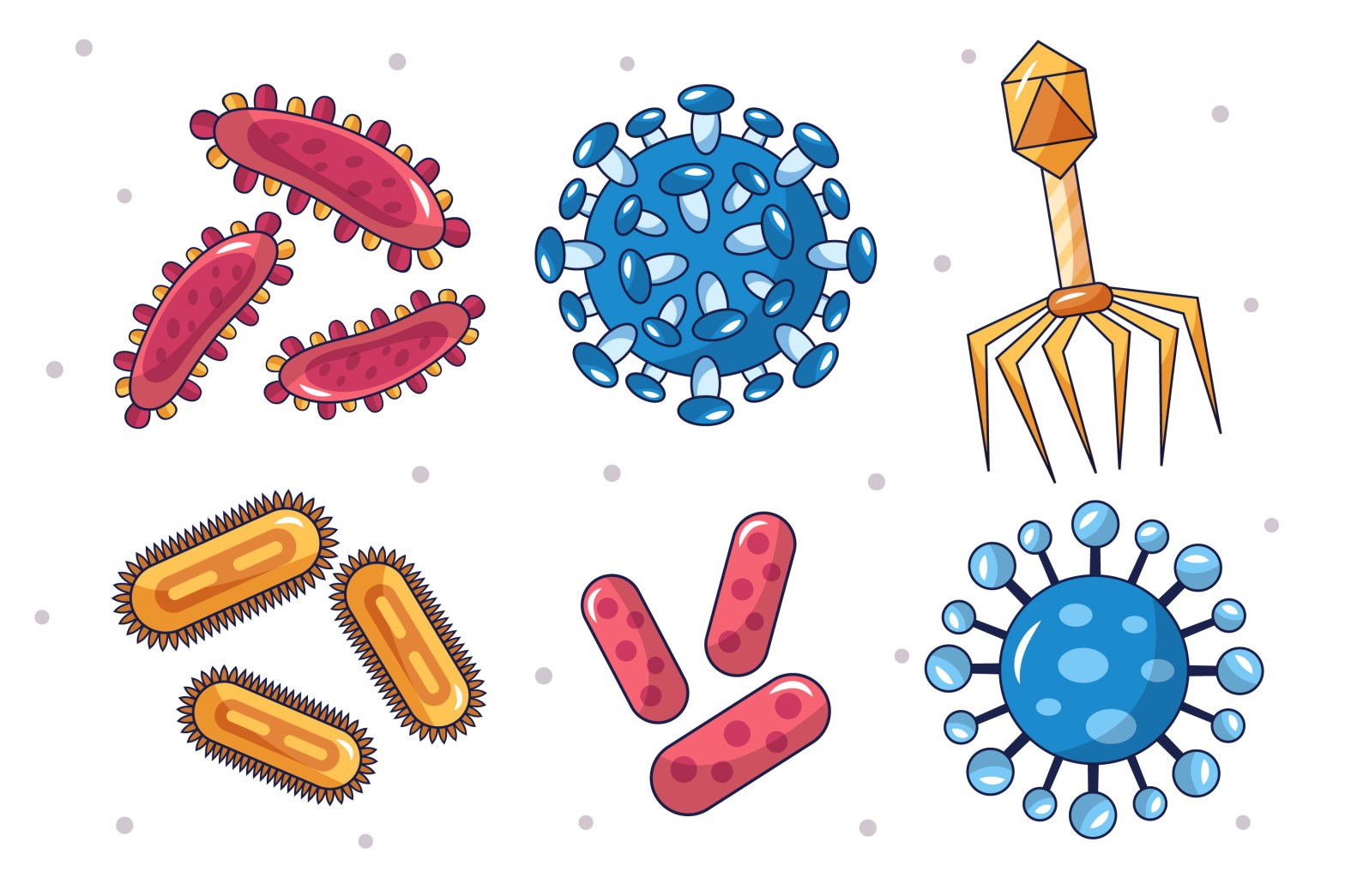
A few days ago, a friend asked me: “What is the difference between viruses and bacteria?”
I believe this is a very interesting question since viruses and bacteria share some characteristics: they are both invisible to the naked eye, can be transmitted from one person to another, and in most cases, we become aware of their presence when they make us ill.
Nevertheless, viruses and bacteria are very different: for starters, bacteria are living organisms, while viruses are not (as I explained in the very first post of this blog The fantastic world of viruses).
Let’s have a look at the main differences between viruses and bacteria.
How do viruses and bacteria look like?
Bacteria are living organisms consisting of one cell (unicellular organisms) belonging to the Prokaryota domain. Their genetic material consists of a single molecule of DNA, but often times they carry smaller additional DNA molecules called plasmids, circular as well, that can be transferred from one bacterium to another, or easily incorporated and released to and from the environment. Bacterial cells are surrounded by a membrane and a cellular wall characteristic of each bacterial species.
On the other hand, viruses are not living organisms but we could say they are simply containers of genetic information. They carry either DNA or RNA in different shapes (linear or circular, in single or multiple molecules). Their DNA or RNA is packed in a structure made of proteins called capsid, and some viruses also have an outer envelope made of proteins and lipids. Moreover, viruses are about 100 times smaller than bacteria.
Where do viruses and bacteria take their energy from?
Bacteria have their own metabolism, meaning that can take energy from nutrients.
Viruses are obligate parasites: they cannot function on their own (they are not living beings!) and rely on the energy, and sometimes the organelles, of the infected cells.
How do viruses and bacteria reproduce?
To replicate, bacteria make an extra copy of their DNA and split all their cellular conent into two identical new cells (binary fission).
Viruses hijack cellular organelles to make several copies of their genetic material and to produce new viral particles. In some viral infections, the presence of all these viral particles makes the cell literally explode: the infected cell dies and the new particles infect neighbouring cells. Other viruses do not kill the infected cell but take advantage of it to keep producing new particles that are continuously released to infect other cells.
What do bacteria and viruses do in the human body?
Some bacteria are intracellular (they need to be inside a human cell to complete their life cycle) but the majority of bacteria are extracellular: they colonise the space between cells, adhere to the surface of tissues and organs, or circulate in the bloodstream.
Not all bacteria make us ill: many of them are symbiotic or commensal, like those of the intestinal and vaginal flora, and those living on our skin. Some of them offer a “service” to our body, for example by digesting substances that the cells of our intestine are not able to, while others help us simply with their presence, impeding dangerous bacteria from occupying that space on our body and causing any disease.
All viruses are intracellular, and most of them are pathogenic, but sometimes infections happen without causing disease (sub-clinical infections).
Sub-clinical infections may be useful to train our immune system to recognize the virus and get rid of it; in other cases, such infectious mislead the immune system making it tolerant to the virus, which in turn can keep replicating and eventually can cause a chronic disease (as in the case of hepatitis B virus).
Viruses and bacteria beyond the human body
Besides the viruses and bacteria that infect the human body, many others infect animals and plants. Others live in the oceans, underground, in the most unhospitable conditions (for example at extreme temperatures or without oxygen), and probably on other planets!
The importance of biotechnology
The advanced knowledge of bacteria and their genes made it possible to develop the so-called “microbial biotechnology”: bacteria are used to produce medicines such as antibiotics, antivirals, antitumorals, and vaccines. Moreover, bacteria have a mechanism to destroy foreign DNA molecules that has been modified and further developed by scientists into one of the most promising tools to cure genetic diseases (CRISPR-Cas).
Similarly, viruses can be our allies thanks to biotechnology. For example, viruses that infect bacteria, called phages, are now studied to develop alternative therapies to cure infections caused by antibiotic-resistant bacteria. Another biotech application that takes advantage of the characteristics of well-known viruses is gene therapy, where viruses are used to transfer functional copies of a gene into the cells of patients with rare diseases.
Image: Cartoons of virus and bacteria (out of scale) by pikisuperstar taken from Freepik
Bibliography
Medical Microbiology, 4th ed, University of Texas Medical Branch at Galveston; Baron S 1996. http://www.ncbi.nlm.nih.gov/books/NBK7627/
Bacterial metabolism in the host and its association with virulence, Bhagwat A et al., Virulence. 2025, http://doi.org/10.1080/21505594.2025.2459336
Viruses and cells intertwined since the dawn of evolution, Durzyńska Jet al., Virol J. 2015, http://doi.org/10.1186/s12985-015-0400-7
Viruses at Large in the Universe, Berliner AJ et al., Astrobiology. 2018, http://doi.org/10.1089/ast.2017.1649
What is the role of microbial biotechnology and genetic engineering in medicine? Santos‐Beneit F. Microbiologyopen. 2024 http://doi.org/10.1002/mbo3.1406
Multi-strain phage induced clearance of bacterial infections, Marchi J et al., PLoS Comput Biol. 2025 http://doi.org/10.1371/journal.pcbi.1012793
Viral Vectors for Gene Transfer, Chen YH et al., CP Mouse Biology. 2018 http://doi.org/10.1002/cpmo.58
 Virus&Co.