Test sierologici per COVID-19: cosa sono e come funzionano

I test sierologici determinano la presenza nel siero (ovvero la parte liquida del sangue che rimane dopo la coagulazione) di specifiche proteine.

Nel caso dei test sierologici per COVID-19 si ricercano nel siero gli anticorpi anti-SARS-CoV-2 (anche gli anticorpi sono proteine).

L’organismo umano produce 5 tipi di anticorpi diversi (IgA, IgD, IgE, IgG e IgM, dove “Ig” sta per immunoglobuline, sinonimo di anticorpi), ma nel caso dell’infezione da SARS-CoV-2 solo IgG e IgM sono di interesse.

Le IgM vengono prodotte nelle fasi iniziali dell’infezione (generalmente entro la prima settimana) e permangono nell’organismo per un breve lasso di tempo. Le IgG vengono invece prodotte circa 10-12 giorni dopo l’inizio dell’infezione, ma restano in circolazione più a lungo (periodo di tempo variabile a seconda del patogeno in questione). Per un certo periodo di tempo sia le IgG che le IgM possono essere presenti nel siero di un individuo.

La presenza di IgM denota che l’infezione è ancora in corso o molto recente, mentre la presenza delle sole IgG indica un’infezione pregressa.

Tra i test sierologici possiamo distinguere quelli quantitativi, capaci di determinare la concentrazione degli anticorpi di interesse, e quelli qualitativi che invece hanno come risultato solo la presenza o assenza degli anticorpi.

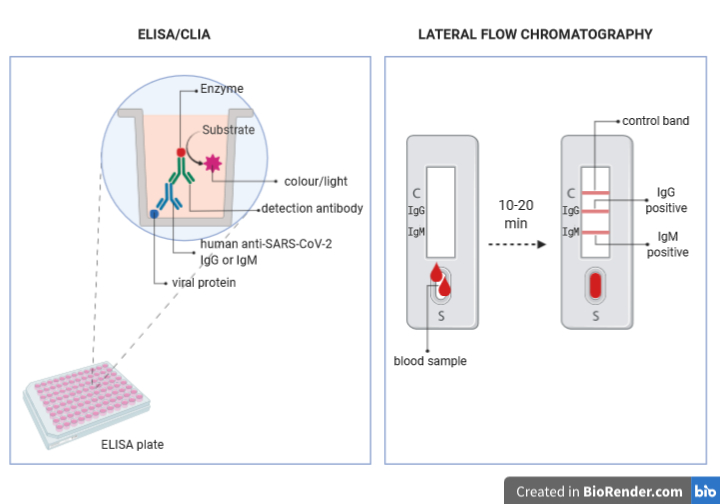
I test che vengono svolti negli ospedali e nei laboratori autorizzati sono quantitativi e sono fondalmentalmente di due tipologie: ELISA (enzyme-linked immunosorbent assay ) e CLIA (chemioluminescence assay).

Il principio alla base di queste tecniche è il seguente:

  • su un supporto solido (il fondo dei pozzetti di una piastra) sono legate in maniera indissolubile le proteine del virus
  • il siero da testare viene aggiunto nei pozzetti  in diverse diluizioni; se nel siero sono presenti gli anticorpi essi si uniranno alle proteine virali
  • un anticorpo capace di riconoscere le IgG o le IgM umane viene aggiunto al pozzetto (anticorpo di detezione); se gli anticorpi anti SARS-CoV-2 erano presenti nel siero del paziente, gli anticorpi di detezione si legheranno ad essi. Gli anticorpi di detezione sono stati modificati in modo da essere uniti (coniugati) ad un estremità a una molecola (enzima) capace di produrre colore (nel caso dell’ELISA) o luce (nel caso del CLIA) quando una molecola specifica (substrato) viene aggiunto al campione.
  • Un apposito substrato viene aggiunto ai pozzetti e si misura l’intensità del colore o della luce prodotti dalla reazione con l’enzima coniugato all’anticorpo di detezione
  • A partire dall’intensità di colore o di luce si calcola la concentrazione di anticorpi anti SARS-CoV-2 presenti nel siero del paziente.

I test rapidi di cui sentiamo parlare spesso in queste ultime settimane sono invece qualitatitivi e si basano su una tecnologia detta Lateral Flow Chromatography.

Il dispositivo per la realizzazione di questo test è una piccola striscia di una resina speciale, in cui sono posizionati in punti diversi degli anticorpi anti-IgM e degli anticorpi anti-IgG.

  • Ad una estremità del dispositivo è presente un pozzetto in cui viene deposta una goccia di sangue che si vuole testare.
  • La parte liquida del sangue (che contiene gli anticorpi) inizierà a muoversi per capillarità lungo la striscia di resina, e incontrerà in una porzione di essa (la camera di coniugazione) delle proteine del virus coniugate a delle particelle d’oro colloidale che hanno un colore rosa-rossastro.
  • Se nel sangue del paziente ci sono degli anticorpi contro le proteine virali si uniranno ad esse e le trascineranno con se mentre continuano a muoversi per capillarità lungo la striscia fino a quando non incontreranno gli anticorpi anti-IgG o anti-IgM legati al dispositivo.
  • L’unione degli anti-anticorpi alle IgG o IgM unite alle proteine virali coniugate con le particelle d’oro colloidale determinerà la comparsa di una banda rossa nel punto in cui sono adesi gli anticorpi, rendendo facilmente visibile la loro presenza o assenza.
  • L’intensità del colore della banda potrà indicarci se gli anticorpi sono tanti o pochi, ma non potremo calcolarne l’esatta concentrazione.

Questi dispositivi hanno anche un sistema di controllo, ovvero una terza banda in cui sono adesi anticorpi che riconoscono anticorpi non umani specifici per altre proteine. Gli anticorpi non umani e le proteine che essi riconoscono coniugate a particelle di oro colloidale si trovano nella camera di coniugazione del dispositivo e si muoveranno per capillarità lungo la resina insieme al campione, finché non incontreranno i loro anti-anticorpi. Solo se la banda di controllo diventerà rossa il test potrà essere considerato valido.

(Quelli appena descritti sono solo due esempi delle tante tecniche in cui gli anticorpi vengono usati come strumenti in laboratorio.)

Immagini create su BioRender.com

Bibliografia:

Immunobiology: The Immune System in Health and Disease. 5th edition.The distribution and functions of immunoglobulin isotypes, Janeway C.A. Jr et al., New York: Garland Science 2001https://www.ncbi.nlm.nih.gov/books/NBK27162/

Chemiluminescent immunoassay technology: what does it change in autoantibody detection?, Cinquanta L. et al., Autoimmun Highlights 2017 https://doi.org/10.1007/s13317-017-0097-2

Enzyme-linked immunosorbent assay (ELISA): the basics,Shah K. et al.British Journal of Hospital Medicine 2016 https://doi.org/10.12968/hmed.2016.77.7.C98

Lateral Flow Technology for Field-Based Applications—Basics and Advanced Developments,O’Farrell B., Topics in Compan An Med 2015 https://doi.org/10.1053/j.tcam.2015.12.003
Serology tests for COVID-19: what they are and how they work

Serology tests detect the presence of specific proteins of interest in the serum (the liquid phase of blood after clotting).

Serology tests for COVID-19 aim to detect in the serum specific antibodies against SARS-CoV-2 (antibodies are proteins as well).

The human body produces 5 different types of antibodies (IgA, IgD, IgE, IgG e IgM, where “Ig” stand for immunoglobulins,another word for antibodies), but in the case of SARS-CoV-2 infection, only IgG and IgM are of interest.

IgM are produced in the initial phases of infection (usually during the first week) and circulate for a limited time. IgG are produced about 10-12 days after the beginning of the infection, but they remain in circulating for longer (how long depends on the specific pathogen). During a certain amount of time, both IgM and IgG can be present in the serum of an individual.

The presence of IgM indicates a very recent or still present infection, while the presence of IgG only indicates a past infection.

Among serology tests, we can distinguish between quantitative tests, able to determine the concentration of the antibodies of interest, and qualitative tests, that determine the presence or absence of the antibodies.

Hospitals and authorised laboratories perform quantitative tests: ELISA (enzyme-linked immunosorbent assay ) and CLIA (chemioluminescence assay).

The principle of these techniques is as follows:

  • Viral proteins are stably linked on a solid support (the bottom of a plate well)
  • The serum to be tested is added to the wells in different dilutions; if the serum contains specific antibodies, they will bind to the viral proteins
  • An antibody able to recognize human IgG or IgM (detection antibody) is added to the well; if the patient serum contained anti-SARS-CoV-2 antibodies, the detection antibodies will bind them. The detection antibodies are modified so that they are bound (conjugated) to a molecule (enzyme) able to produce colour (in the case of ELISA) or light (in the case of CLIA) when a specific molecule (substrate) is added to the sample.
  •  The appropriate substrate is added to the wells and the intensity of the colour or of the light produced by the reaction with the enzyme conjugated to the detection antibody, and its intensity is measured.
  • Based on the intensity of the colour or light, the concentration of the anti-SARS-CoV-2 antibodies present in the patient serum is calculated.

The rapid tests that have become so popular in the last weeks are qualitative tests based on a technology named Lateral Flow Chromatography.

The device to perform these tests are little strips of a special resin, where ant-IgM and anti-IgG are placed in different points.

  • A drop of blood to be tested is placed in a well at one extremity of the device.
  • The liquid phase of the blood (containing the antibodies) will flow by capillarity through the strip and it will go across the conjugation chamber, where it will encounter viral proteins conjugated to colloidal gold (pink-red coloured).
  • If the patient blood contains antibodies against the viral proteins, they will bind them and they will carry them while flowing in the strip until they encounter the anti-IgG or anti-IgM bound to the device.
  • The binding of the anti-antibodies to the IgG or IgM bound to the viral proteins conjugated to the colloidal gold particles, will determine the appearance of a red band, revealing the presence or absence of the antibodies ion the sample.
  • The intensity of the band can indicate whether there is a small or big amount of antibodies in the sample, but it will not be possible to calculate their exact concentration.

These devices have also a control system, that is a third band to which antibodies that recognize non-human antibodies against other proteins are bound. Those non-human antibodies and their target proteins are placed in the conjugation chamber and will move by capillarity through the strip together with the sample until they reach their anti-antibodies. Only if the control band turns red, the test will be considered valid.

(These are just two examples of the many techniques in which antibodies are used as tools in the lab.)

Images created in BioRender.com

Bibliography:

Immunobiology: The Immune System in Health and Disease. 5th edition.The distribution and functions of immunoglobulin isotypes, Janeway C.A. Jr et al., New York: Garland Science 2001https://www.ncbi.nlm.nih.gov/books/NBK27162/

Chemiluminescent immunoassay technology: what does it changein autoantibody detection?, Cinquanta L. et al., Autoimmun Highlights 2017 https://doi.org/10.1007/s13317-017-0097-2

Enzyme-linked immunosorbent assay (ELISA): the basics,Shah K. et al.British Journal of Hospital Medicine 2016 https://doi.org/10.12968/hmed.2016.77.7.C98

Lateral Flow Technology for Field-Based Applications—Basics and Advanced Developments,O’Farrell B., Topics in Compan An Med 2015 https://doi.org/10.1053/j.tcam.2015.12.003

Alla ricerca di microbi extraterrestri

Una delle domande che ognuno di noi si è posto almeno una volta nella vita è: c’è vita su altri pianeti?

Nell’immaginario collettivo questa domanda richiama esserini verdi con le antenne, ma quando gli scienziati parlano di forme di vita extraterrestri si riferiscono a entità microscopiche, più simili ai batteri che agli umani.

L’Agenzia Spaziale Americana (NASA) definisce l’Astrobiologia come lo studio dell’origine, evoluzione e distribuzione della vita nell’universo. Oltre a cercare ambienti abitabili su altri pianeti del Sistema solare, l’astrobiologia si propone di comprendere l’origine, l’evoluzione e la diversità della vita sul pianeta Terra.

Sul nostro pianeta esistono delle forme di vita capaci di vivere in condizioni estreme (organismi estremofili), per esempio a temperature molto alte (termofili come Thermus aquaticus) o molto basse (psicrofili come Psychrobacter), nel vuoto (come i tardigradi) o in assenza di ossigeno (anaerobi come Chlostridium tetani). Poiché quello che sappiamo sulla vita deriva da ciò che conosciamo del nostro pianeta, gli studi in corso si basano sulla ricerca in altri pianeti di elementi simili a quelli terrestri, anche in ambienti che potrebbero sembrare a prima vista inospitali.

Il programma ExoMars dell’Agenzia Spaziale Europea (ESA), per esempio, ha l’obiettivo di studiare le condizioni ambientali su Marte, per capire se il pianeta rosso possa ospitare forme di vita o se l’abbia fatto in passato. Il programma comprende due missioni, la prima iniziata nel 2016, e la seconda fissata per il 2022, con l’obiettivo di raccogliere campioni del suolo di Marte, cercare segni di vita presenti o passati, analizzare cambiamenti idrogeologici del pianeta e studiarne la composizione dell’atmosfera.

Precedenti missioni su Marte hanno registrato la presenza di metano (CH4). Il metano è uno dei gas che compongono l’atmosfera terrestre, e per il 90% ha un’origine biologica, ovvero viene prodotto da esseri viventi. Le missioni ExoMars intendono, tra le altre cose, confermare la presenza di CH4 gassoso nell’atmosfera di Marte e determinarne l’origine, che potrebbe essere biologica o geologica. Se si trattasse di metano di origine biologica, esso potrebbe essere stato prodotto da batteri presenti milioni di anni fa ed essere rimasto intrappolato nel sottosuolo per essere rilasciato gradualmente nell’atmosfera fino ai nostri giorni, oppure esso potrebbe essere prodotto da batteri tuttora esistenti capaci di vivere nelle estreme condizioni ambientali di Marte.

Le altre sostanze che verranno cercate su Marte sono gli zuccheri e gli amminoacidi, due elementi essenziali che costituiscono gli esseri viventi terrestri. Una caratteristica di queste molecole è che esse esistono in due forme speculari (enantiomeri), ma sul pianeta Terra gli organismi viventi sono in grado di produrre e usare solo una di queste forme per costruire i carboidrati e le proteine (omochiralità). La sintesi chimica di questi elementi invece produce una miscela di quantità uguali di entrambi gli enantiomeri (miscela racemica). Studiando la composizione di questi elementi su Marte, la presenza di omochiralità sarebbe un indizio a favore della presenza della vita sul pianeta rosso.

E se su Marte esistessero davvero delle forme di vita come i batteri, essi sarebbero capaci di vivere anche sul pianeta Terra? Potrebbero infettare l’uomo o altri organismi terrestri?

E i microorganismi terrestri sarebbero capaci di sopravvivere in altri pianeti?

Recentemente, un gruppo di ricerca del Radboud University Medical Center, nei Paesi Bassi, ha cercato di rispondere a quest’ultima domanda.

I ricercatori hanno fatto crescere quattro specie diverse di batteri terrestri (P. aeruginosa, B. cepacia, K.pneumoniae, e S. marcescens) in un terreno di coltura composto da acqua, ammonio, zolfo, fosforo e ferro, e aggiungendo come fonte di carbonio degli zuccheri precedentemente identificati in frammenti di meteoriti. I batteri sono riusciti a crescere su questi terreni di coltura, anche se più lentamente che in presenza di uno zucchero terrestre (glucosio). I batteri cresciuti con fonti di carbonio diverse dal glucosio in questi esperimenti, presentavano dei cambiamenti nella struttura della membrana esterna, che risultava in un’alterazione dell’interazione con le cellule del sistema immunitario umano. Le cellule umane rispondevano in maniera più forte o più debole al contatto con questi batteri a seconda dello zucchero di cui si erano nutriti.

Questi esperimenti indicano che batteri terrestri che potrebbero arrivare su altri pianeti con le missioni spaziali (per esempio tramite strumenti contaminati), potrebbero adattarsi alle nuove condizioni modificando alcune delle loro caratteristiche. Per questo motivo una profonda decontaminazione di tutti gli strumenti e gli oggetti usati nelle missioni spaziali è di estrema importanza.

Poiché sulla Terra tutte le forme viventi compresi i batteri sono associate a dei virus capaci di infettarle, e dato che nel nostro pianeta le particelle virali sono le entità biologiche più abbondanti in assoluto nel n, se venisse confermata la presenza di batteri su altri pianeti, non sarebbe da escludere l’esistenza anche di virus extraterrestri. Al momento però, non ci sono missioni in corso per determinare la presenza di virus nello spazio.

Immagine presa da http://www.publicdomainpictures.net

Bibliografia

Agenzia Spaziale Europea: https://exploration.esa.int/web/mars/-/43608-life-on-mars

Istituto di Astrobiologia della NASA: https://nai.nasa.gov/about/

Immune recognition of putative alien microbial structures: Host–pathogen interactions in the age of space travel, Netea M.G. et al., PLoS Pathogens 2020 https://doi.org/10.1371/journal.ppat.1008153

Growth on Carbohydrates from Carbonaceous Meteorites Alters the Immunogenicity of Environment-Derived Bacterial Pathogens, Domínguez-Andrés J. et al., Astrobiology 2020 https://doi.org/10.1089/ast.2019.2173

Astrovirology: Viruses at Large in the Universe, Berliner A.J. et al., Astrobiology 2018, https://doi.org/10.1089/ast.2017.1649

Searching for extraterrestrial microbes

All of us, at least once, have asked this question: there is life on other planets?

When thinking about extraterrestrial life we usually imagine little green creatures with antennae on their head, but what scientists are looking for are microscopic organisms, more similar to bacteria than to humans.

The American National Aeronautics and Space Administration (NASA) defines Astrobiology as the study of the origin, evolution, and distribution of life in the universe. Not only the astrobiologists look for habitable environments on other planets of the Solar System, but they also try to understand the origin, evolution, and diversity of life on the Earth.

Some organisms on our planet can live under extreme conditions (extremophiles), for example at very high or very low temperatures (thermophiles like Thermus aquaticus or psychrophiles like Psychrobacter), in the vacuum (like tardigrades) or in the absence of oxygen (anaerobic like Chlostridium tetani). Since what we know about living organisms come from our knowledge on our planet, the current studies are based on the search on other planets of elements similar to those found on the Earth, even in environments that can look extremely inhospitable at a first sight.

The ExoMars program of the European Space Agency (ESA), for example, aims at studying the environmental conditions on Mars, to determine whether it can host living beings, or if it could have been possible in the past. The program consists of two missions, the first one launched in 2016 and the second one scheduled for 2022, to collect samples of Mars soil, search for traces of life, analyse hydrogeologic changes in the planet and study its atmosphere composition.

Previous missions on Mars have detected methane (CH4). Methane is also present in our atmosphere, and  90% of it has a biotic origin, meaning that it is produced by living organisms. The ExoMars missions want, among other things, confirm the presence of gaseous CH4 in Mars atmosphere and determine its origin. If its biotic origin were confirmed, it could have been produced by bacteria millions of years ago and stored under the surface of the planet to be gradually released to date, or it could be produced by bacteria currently living in Mars extreme environment.

The two missions will also search for sugars and amino acids, two building blocks of the terrestrial living organisms. An important characteristic of both these two classes of molecules is that they exist in two forms that are the mirror image of one another (enantiomers); however, terrestrial organisms can produce and use only one of those forms to build their carbohydrates and proteins (homochirality), while when they are chemically synthesized an equal mixture of both enantiomers is produced (racemic mixture). The presence of homochirality of sugars and amino acids on Mars would suggest that there is (or there was once) life on the red planet.

But if there are living organisms similar to bacteria on Mars, would be they able to survive also on Earth? Could they infect humans or other terrestrial organisms?

And conversely, would terrestrial microorganisms be able to survive on other planets?

Recently, scientists of the Radboud University Medical Center in the Netherlands, have tried to answer this latter question.

They cultured four different species of terrestrial bacteria (P. aeruginosa, B. cepacia, K.pneumoniae, and S. marcescens) in a medium containing water, ammonium, sulfur, phosphorus, and iron, and supply as a source of carbon different sugars previously identified on meteorites. The bacteria were able to grow on those culture media, even if slower than in the presence of a terrestrial sugar (glucose). Bacteria exposed to carbon sources other than glucose in these experiments showed structural changes in their external membrane, that in turn altered their interaction with human immune cells. Human cells responded in a stronger of weaker manner upon contact with those bacteria, depending on the sugar they were fed with.

These experiments suggest that terrestrial microorganisms that could arrive on other planets during space missions (for example through contaminated tools), might adapt two new conditions and modify some of their characteristics. This is why deep contamination of all the tools and objects used in space missions is extremely important.

Given that on Earth all living organisms including bacteria have viruses able to infect them, and that viral particles are the most abundant biological entities on our planet, if the presence of bacteria on other planets was confirmed, it would be reasonable to speculate about extraterrestrial viruses. However, at the moment, the search for viruses in the universe is not among the goals of any of the current space programs.

Figure taken from http://www.publicdomainpictures.net

Bibliography

European Space Agency: https://exploration.esa.int/web/mars/-/43608-life-on-mars

NASA Astrobiology Institute: https://nai.nasa.gov/about/

Immune recognition of putative alien microbial structures: Host–pathogen interactions in the age of space travel, Netea M.G. et al., PLoS Pathogens 2020 https://doi.org/10.1371/journal.ppat.1008153

Growth on Carbohydrates from Carbonaceous Meteorites Alters the Immunogenicity of Environment-Derived Bacterial Pathogens, Domínguez-Andrés J. et al., Astrobiology 2020 https://doi.org/10.1089/ast.2019.2173

Astrovirology: Viruses at Large in the Universe, Berliner A.J. et al., Astrobiology 2018, https://doi.org/10.1089/ast.2017.1649

La doppia elica del DNA: il segreto della vita

Taken from freepik.com

Il 25 aprile 1953 venne pubblicato su Nature l’articolo di James Watson e Francis Crick che descriveva la struttura del DNA: la doppia elica più famosa di tutti i tempi.

La scoperta del DNA

La storia del DNA era iniziata circa un secolo prima, quando, nel 1869, il chimico svizzero Friedrich Miescher scoprì che all’interno del nucleo dei globuli bianchi era presente una sostanza diversa dalle proteine, che chiamò nucleina.

Nel 1919, il biochimico russo Phoebus Levene scoprì che questa molecola, che nel frattempo era stata ribattezzata acido nucleico, era composta da unità ripetute che chiamò nucleotidi.

Ogni nucleotide è composto da:

  • una base azotata tra adenina (A), timina (T), citosina (C) e guanina (G)
  • uno zucchero
  • un gruppo fosfato (PO43-).

Fu Levene a caratterizzare due diverse forme di acidi nucleici: l’RNA, che ha come zucchero il ribosio, e il DNA, che ha come zucchero il deossiribosio.

La corsa alla struttura del DNA

Le scoperte di Levene diedero il via alla ricerca sulla struttura del DNA. Egli stesso propose un modello secondo cui le basi si ripetevano sempre nello stesso ordine. Con il tempo si capì che il DNA aveva una forma tridimensionale regolare e in tanti cercarono di decifrarla: nel febbraio 1953 il chimico statunitense Linus Pauling ci andò vicino, proponendo una struttura formata da tre eliche arrotolate l’una sull’altra.

Il 25 aprile 1953 vennero pubblicati contemporaneamente sullo stesso numero di Nature ben tre articoli sulla struttura del DNA; tra i essi tre quello di Watson e Crick era il più completo, e i due scienziati già due mesi prima avevano annunciato nel famoso Eagle Pub di Cambridge di aver scoperto “il segreto della vita”.

Anche Rosalind Franklin e Maurice Wilkins (autori degli altri due articoli) svolsero un ruolo centrale nell’elaborazione della teoria di Watson e Crick, come ho raccontato in un altro post.

DNA e RNA

Il DNA è composto da due catene uguali ma orientate in direzioni opposte (antiparallele) di nucleotidi che si appaiano formando una doppia elica. Questo appaiamento non è casuale, ma segue le regole di Watson-Crick: se su una catena è presente una A essa si appaierà solo con una T sul filamento opposto, mentre una C potrà appaiarsi solo con una G. L’ordine di queste basi lungo una catena (sequenza), invece, è altamente variabile, ed è possibile un numero elevatissimo di combinazioni.

L’RNA, a differenza del DNA, è formato da una singola elica, e al posto della T contiene un’altra base azotata, l’uracile (U).

Dal DNA alle proteine: il codice genetico

Il DNA contiene tutte le informazioni necessarie per “costruire” le cellule sotto forma di geni, che non sono altro che sequenze di proteine.

Queste informazioni vengono trascritte, ovvero trasferie su un filamento di RNA detto messaggero (mRNA) secondo le regole di Watson-Crick, con la differenza che quando sul DNA c’è una A, nell’mRNA viene inserita una U.

L’mRNA esce dal nucleo e si dirige verso dei piccoli organelli cellulari detti ribosomi che sono capaci di tradurre queste istruzioni in proteine.

Le proteine sono formate da combinazioni di 20 unità diverse chiamate amminoacidi. Gli scienziati si posero il problema di capire come un alfabeto di 4 lettere (le basi degli acidi nucleici) potesse essere tradotto in un alfabeto di 20 lettere (gli amminoacidi delle proteine). Ancora una volta fu il lavoro svolto indipendentemente da tanti scienziati a svelare il mistero: gli studi di Severo OchoaFrancis CrickMarshall Nirenberg, e Har Gobind Khorana tra gli altri, permisero di capire che sequenze specifiche di tre basi azotate codificano per uno specifico amminoacido e di decifrare il codice genetico.

Il meccanismo che permette la lettura e l’esecuzione delle istruzioni scritte nei geni è riassunto in quello che viene chiamato dogma centrale della biologia molecolare.

Il dogma centrale della biologia molecolare. Immagine di Carla Usai creata con BioRender.com

Oltre il DNA: il genoma umano

La scoperta della struttura del DNA ha dato il via ad altre scoperte e alla comparsa di nuove tecniche che hanno permesso il sequenziamento del genoma umano, ovvero la determinazione della sequenza di basi di tutto il DNA delle cellule umane. Il Progetto Genoma Umano (iniziato nel 1990 e concluso nel 2003) si poneva l’obiettivo di caratterizzare la sequenza e la funzione di tutti i geni umani, nonché la loro posizione relativa, e di disegnare delle mappe per seguire i caratteri genetici da una generazione alla successiva, con particolare attenzione per le malattie genetiche.

Queste conoscenze unite alle moderne biotecnologie e hanno permesso lo sviluppo di nuove forme di fare medicina come la terapia genica e la terapia cellulare.

Bibliografia

Discovery of DNA structure and function: Watson and Crick.  Pray, L. Nature Education 1(1):100, 2008 https://www.nature.com/scitable/topicpage/discovery-of-dna-structure-and-function-watson-397/

The structure of yeast nucleic acid: IV. Ammonia hydrolysis. Levene P., J. Biol. Chem. 40: 415-. 1919 https://www.jbc.org/content/40/2/415.full.pdf

A Proposed Structure For The Nucleic Acids. Pauling L. and Corey R., Proc Natl Acad Sci U S A, Feb; 39(2): 84–97,1953. https://doi.org/10.1073/pnas.39.2.84

A structure for deoxyribose nucleic acid. Watson, J. D., & Crick, F. H. C., Nature 171, 737–738, 1953 https://doi.org/10.1038/171737a0

Molecular Structure of Deoxypentose Nucleic Acids.,  Wilkins M. et al., Nature 171, 738-740, 1953 https://doi.org/10.1038/171738a0

Molecular Configuration in Sodium Thymonucleate, Franklin R. and Gosling R., Nature 171, 740-741, 1953 https://doi.org/10.1038/171740a0

General nature of the genetic code for proteins. Crick, F. H. C., et al., Nature 192, 1227–1232, 1961 https://doi.org/10.1038/1921227a0

RNA codewords and protein synthesis, VII. On the general nature of the RNA code. Niremberg M. et al, Proc Natl Acad Sci U S A. 53(5): 1161–1168, 1965 https://doi.org/10.1073/pnas.53.5.1161

Il Progetto Genoma Umano: https://www.genome.gov/human-genome-project

The double helix of DNA: the secret of life

Taken from freepik.com

On April 25th 1953, the article describing the DNA double helix by James Watson and Francis Crick was published in Nature.

The discovery of DNA

The history of DNA had begun about one century earlier by the Swiss chemist Friedrich Miescher, who, in 1869, discovered a substance within the nuclei of white blood cells, and he called it nuclein.

In 1919, Russian Biochemist, Phoebus Levene discovered that this molecule, renamed nucleic acid, was composed of repeated units that he called nucleotides.

Each nucleotide is made of:

  • a nitrogenous base between adenine (A), thymine (T), cytosine (C) or guanine (G)
  • a sugar molecule
  • a phosphate group (PO43-).

Levene characterised two different forms of nucleic acids: RNA, which has ribose as sugar, and DNA, which has deoxyribose instead.

The race to discover the structure of DNA

Levene’s discoveries paved the way to further research on the structure of DNA. Levene himself suggested a model in which the four bases were always repeated in the same order. With time, it became clear that DNA has a regular tridimensional shape, and many scientists tried to unveil it: in February 1953, Linus Pauling almost got there, suggesting a structure made of three intertwined helices.

On April 25th 1953, three papers about the structure of DNA were published in the same issue of Nature. The paper by Watson and Crick was the most complete among them, and the two scientists had already announced two months earlier, in the Eagle Pub in Cambridge, that they had discovered “the secret of life”.

Rosalind Franklin and Maurice Wilkins, authors of the other two papers, had played important roles in Watson and Crick’s theory elaboration, as I mentioned in another post.

DNA and RNA

DNA is made of two identical strands of nucleotides running in opposite directions (antiparallel) that assemble in a double helix. The way the two strands match is not random, but follows the Watson-Crick base-pairing rules: if on one strand there is an A it will only match with a T on the opposite strand, while a C will only pair with a G. Nevertheless, the order of the bases on a strand (the sequence) is extremely variable, and a huge number of combinations is possible.

On the other hand, RNA is a single helix, and it presents with a different base, uracil (U), in the place of thymidine.

From DNA to proteins: the genetic code

The DNA carries all the instructions to build the cells, in the form of genes, which are sequences of nucleotide. Such information is transferred (transcribed) on an RNA strand called messenger (mRNA) following the Watson-Crick rules, with the difference that a U is inserted every time the DNA strand carries an A. The mRNA travels from the nucleus of the cell to little organelles called ribosomes, that translate these instructions into proteins.

The proteins are sequences of 20 different units called amino acids. The scientists faced the challenge of understanding how a 4-letter alphabet (the 4 bases of the nucleic acids) could be translated into a 20-letter alphabet (the 20 amino acids of the proteins). Once again, the work of many researchers was necessary to unravel the mystery: the studies of Severo Ochoa, Francis Crick, Marshall Niremberg, and Har Gobind Khorana among others, allowed to decipher the genetic code, in which specific blocks of three bases correspond to one specific amino acid.

The mechanism reading and performing the instructions carried in the genes is known as the central dogma of molecular biology.

The central dogma of molecular biology. Created with BioRender.com by Carla Usai

Beyond DNA: the human genome

With the discovery of the DNA structure, numerous other findings and the advancement of techniques became possible, such as determining the full sequence of human DNA, the human genome. The Human Genome Project (started in 1990 and completed in 2003) had the aim of determining the sequence and function of all the human genes, and their relative position in the DNA, and to build maps to follow the inheritance of genetic traits through generations, with a particular focus on genetic diseases.

This knowledge, combined with modern biotechnology, led to new forms of medicine such as gene therapy and cellular therapy.

Bibliography

Discovery of DNA structure and function: Watson and Crick.  Pray, L. Nature Education 1(1):100, 2008 https://www.nature.com/scitable/topicpage/discovery-of-dna-structure-and-function-watson-397/

The structure of yeast nucleic acid: IV. Ammonia hydrolysis. Levene P., J. Biol. Chem. 40: 415-. 1919 https://www.jbc.org/content/40/2/415.full.pdf

A Proposed Structure For The Nucleic Acids. Pauling L. and Corey R., Proc Natl Acad Sci U S A, Feb; 39(2): 84–97,1953. https://doi.org/10.1073/pnas.39.2.84

A structure for deoxyribose nucleic acid. Watson, J. D., & Crick, F. H. C., Nature 171, 737–738, 1953 https://doi.org/10.1038/171737a0

Molecular Structure of Deoxypentose Nucleic Acids.,  Wilkins M. et al., Nature 171, 738-740, 1953 https://doi.org/10.1038/171738a0

Molecular Configuration in Sodium Thymonucleate, Franklin R. and Gosling R., Nature 171, 740-741, 1953 https://doi.org/10.1038/171740a0

General nature of the genetic code for proteins. Crick, F. H. C., et al., Nature 192, 1227–1232, 1961 https://doi.org/10.1038/1921227a0

RNA codewords and protein synthesis, VII. On the general nature of the RNA code. Niremberg M. et al, Proc Natl Acad Sci U S A. 53(5): 1161–1168, 1965 https://doi.org/10.1073/pnas.53.5.1161

The Human Genome Project: https://www.genome.gov/human-genome-project

Vaccini, anticorpi e immunità di gregge (in breve)

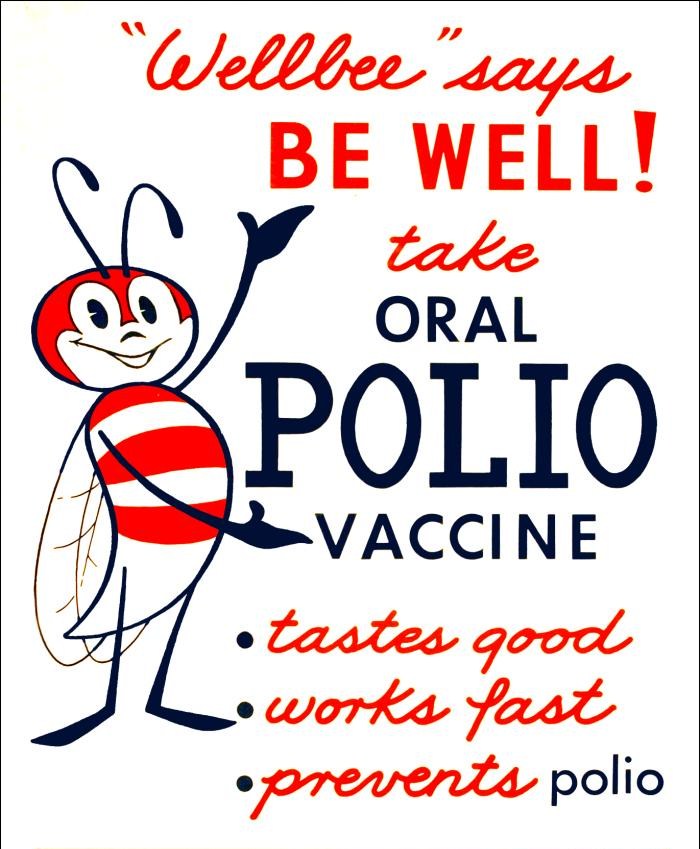
Poster del vaccino antipolio del 1963
Dalla Public Health Image Library del CDC #7224 (Dominio Pubblico)

Abbiamo iniziato il 2020 alle prese con un virus emergente: abbiamo dovuto modificare drasticamente il nostro stile di vita per tentare di limitarne la diffusione e siamo più che mai consapevoli della pericolosità dei virus e delle malattie infettive in genere. Molti sperano in un vaccino e si chiedono quando sarà disponibile.

Le infezioni possono essere mortali

Le malattie infettive hanno segnato la storia dell’umanità: ne sono esempi formidabili la peste nera del 1347-1350 che uccise un terzo della popolazione mondiale, e l’influenza detta “Spagnola” del 1918 che causò circa 100 milioni di morti in tutto il mondo e ridusse alla metà la popolazione europea.

A parte questi esempi presi dai libri di storia, esistono molte altre malattie infettive mortali tra cui il morbillo, la difterite o la poliomielite. Queste infezioni non causano più l’enorme numero di vittime del passato grazie alla disponibilità di vaccini specifici, ma non bisogna dimenticare la loro potenziale pericolosità. Il morbillo, per esempio, causava in media 2.6 milioni di morti all’anno prima del 1963, anno di introduzione della vaccinazione, mentre nel 2018 il numero delle vittime è sceso a 140.000 in tutto il mondo.

Chi ha inventato i vaccini?

La vaccinazione fu inventata da Edward Jenner nel 1796.

Nel XVIII secolo il vaiolo era di casa in Europa e uccideva 400.000 persone ogni anno. Tutti sapevano che chi sopravviveva al vaiolo diventava immune a una seconda infezione. Si sapeva inoltre che le mungitrici esposte al vaiolo bovino mediante il contatto con le pustole delle vacche infette, erano immuni al vaiolo umano. Jenner pensò che il vaiolo bovino potesse essere trasmesso artificialmente da una persona all’altra per conferire immunità contro il vaiolo umano. Per testare la sua ipotesi prelevò del materiale da una pustola di una mungitrice con il vaiolo bovino e lo introdusse in un bambino di 8 anni (James Phipps) tramite una piccola ferita nella pelle. Il bambino sviluppò immediatamente febbre e malessere, ma i sintomi passarono in pochi giorni. Due mesi dopo Jenner introdusse nel bambino del materiale proveniente da una pustola di una persona con il vaiolo umano: James non si ammalò e Jenner concluse che il suo metodo funzionava!

Nel 1797 Jenner mandò una comunicazione con la descrizione del suo esperimento alla Royal Society, ma non ricevette la considerazione che meritava e il suo articolo non venne pubblicato. L’anno successivo, però, Jenner riuscì a pubblicare un opuscolo contenente molti più casi ed osservazioni (“An Inquiry into the Causes and Effects of the Variolae Vaccinae, a disease discovered in some of the western counties of England, particularly Gloucestershire and Known by the Name of Cow Pox”) facendo conoscere la sua tecnica agli altri scienziati.

Poichè il materiale che Jenner usava per la sua tecnica proveniva dalle vacche (era quindi vaccino), questa tecnica venne in seguito chiamata vaccinazione.

La pratica della vaccinazione si diffuse, e il vaccino di Jenner consentì l’eradicazione del virus del vaiolo (Variola virus) nel 1980, ovvero la sua scomparsa a livello mondiale. Se il vaiolo fosse un animale diremmo che si è estinto; ciò è accaduto perché la maggior parte della popolazione era diventata immune e il virus non aveva a disposizione abbastanza individui da infettare e da cui diffondersi.

Come sono fatti i vaccini moderni?*

I vaccini attualmente in uso contengono uno di questi elementi:

– microrganismi attenuati, cioè che non sono più stati n grado di causare la malattia (sono stati resi non patogeni)

– microorganismi inattivati (uccisi) tramite esposizione al calore o sostanze chimiche

proteine o parti di proteine del microrganismo (vaccini a subunità)

tossoidi, ovvero tossine sostanze normalmente prodotte dal microorganismo ma rese innocue in laboratorio.

Come funzionano i vaccini?

Quando un vaccino viene inettato, le sostanze che lo compongoo richiamano le cellule del sistema immunitario nel sito dell’iniezione, provocando un’infiammazione localizzata. Queste cellule sono chiamate cellule presentanti l’antigene (APC). Le APC inglobano il materiale che compone il vaccino e lo trasportano ai linfonodi, dove “presentano” i componenti del vaccino (antigeni) ad altre cellule del sistema immunitario: i linfociti T. I linfociti T capaci di riconoscere quei determinati antigeni iniziano a proliferare e interagiscono con i linfociti B, che a loro volta devono saper riconoscere specificamente quegli antigeni per iniziare a moltiplicarsi. I linfociti B così selezionati escono dai linfonodi e circolano nel sangue producendo anticorpi.

Questa prima fase di presentazione e riconoscimento dell’antigene è comune all’infezione naturale e alla vaccinazione, con la differenza che la vaccinazione non è seguita dalla malattia.

I linfociti T si occupano di uccidere le cellule infettate (e con esse il microorganismo che si trova dentro di esse), mentre i linfociti B producono una grande quantità di anticorpi che “attaccano” il microorganismo contribuendo alla sua eliminazione.

Quanto dura l’effetto di un vaccino?

Dopo questa prima fase la maggior parte dei linfociti B e T che hanno proliferato vengono eliminati dal nostro corpo, ma alcune di queste cellule sopravvivono e si trasformano in cellule della memoria. Si tratta di sentinelle che continuano ad essere presenti nel nostro organismo, pronte a riconoscere e ad attaccare rapidamente il patogeno nel caso si ripresenti una seconda volta. Inoltre gli anticorpi prodotti restano in circolazione per un periodo di tempo variabile.

È per questo che quando ci vacciniamo diventiamo immuni a una malattia: abbiamo già pronti anticorpi e linfociti B e T che elimineranno il microrganismo in tempi rapidissimi all’inizio dell’infezione. La maggior parte delle volte non ci accorgeremo neanche del tentativo di invasione, o al massimo il microorganismo avrà giusto il tempo di causare dei lievi sintomi prima di essere eliminato.

Perché è importante vaccinarsi?

Dai tempi di Jenner sono stati fatti molti progressi: dopo che Louis Pasteur ha dimostrato che i germi causano le malattie, e grazie a una migliore conoscenza dell’immunologia, sono stati sviluppati molti altri vaccini. I vaccini hanno contribuito a diminuire la mortalità infantile, migliorare lo stato di salute generale e ad aumentare l’aspettativa di vita della popolazione mondiale. I vaccini sono considerati tra le più grandi conquiste del progresso in ambito sanitario insieme alla potabilizzazione dell’acqua e agli antibiotici.

Cos’è l’immunità di gregge?

La vaccinazione protegge non solo gli individui vaccinati ma anche il resto della popolazione perché limita la diffusione del patogeno; questo fenomeno, detto immunità di gregge, richiede però che la maggioranza della popolazione sia vaccinata (75-95% a seconda del patogeno in questione). L’ideale sarebbe quindi che tutti gli individui sani si vaccinassero per proteggere tramite l’immunità di gregge coloro che non possono vaccinarsi, i soggetti immunocompromessi (il cui sistema immunitario non funziona correttamente) o i neonati che non sono stati ancora vaccinati.

I nuovi vaccini*

Le tecnologie attuali permettono di studiare le malattie infettive e di progettare nuovi vaccini molto più sofisticati. Da una parte siamo capaci di sequenziare i genomi dei virus e dei batteri e di predire con sistemi informatici quali proteine saranno riconosciute con maggiore probabilità ed efficienza dalle cellule del sistema immunitario (Vaccinologia Inversa), e dall’altra è possibile sequenziare i linfociti B di chi ha già avuto la malattia per studiare quali anticorpi tra tutti quelli che l’organismo ha prodotto sono i più efficaci per intercettare il microorganismo (Vaccinologia Inversa 2.0). Gli scienziati stanno anche esplorando nuovi tipi di vaccini contenenti frammenti di RNA e DNA dei microorganismi con l’obiettivo di ottenere vaccini migliori.

Definizioni utili

Immunità: protezione contro una malattia infettiva; se si è immuni nei confronti di un agente infettivo ci si può esporre ad essi senza sviluppare la malattia.

Immunizzazione: processo mediante il quale una persona diventa immune a una malattia infettiva tramite la vaccinazione.

Vaccinazione: introduzione all’interno di un organismo di materiale disegnato per provocare una risposta immunitaria che darà protezione nei confronti di un determinato agente infettivo

Vaccino: prodotto che stimola il sistema immune di un individuo per conferire immunità verso un determinato agente infettivo, proteggendolo dalla malattia.

Plasmacellule: linfociti B che producono grandi quantità di anticorpi.

Anticorpi: proteine prodotte dal sistema immunitario capace di riconoscere specificamente parti di microrganismi durante un’infezione.

*Nota dell’autrice: Questo post è stato scritto e pubblicato ad aprile 2020, nelle prime fasi della pandemia di COVID-19. Alla fine del 2020 è iniziata la somministrazione su scala globale dei vaccini anti-SARS-CoV-2, prevalentemente a mRNA o basati su vettori virali. Il funzionamento di questi vaccini è stato trattato in altri post: https://virusandco.art.blog/2020/11/23/i-vaccini-di-pfizer-e-moderna-risultati-promettenti-in-tempi-record/ e https://virusandco.art.blog/2021/01/13/il-vaccino-oxford-astra-zeneca-un-vaccino-basato-su-un-vettore-virale/

BIBLIOGRAFIA

Organizzazione Mondiale della Sanità: https://www.who.int/topics/vaccines/en/ ; https://www.who.int/news-room/fact-sheets/detail/measles ; https://www.who.int/csr/disease/smallpox/en/

European Centre for Disease Prevention and Control: https://www.ecdc.europa.eu/en/immunisation-vaccines/facts/vaccine-preventable-diseases

Centers for Disease Control and Prevention: https://www.cdc.gov/vaccines/vpd/vaccines-list.html ; https://www.cdc.gov/vaccines/vac-gen/imz-basics.htm

Trascrizione della pubblicazione originale di Edward Jenner: https://biotech.law.lsu.edu/cphl/history/articles/jenner.htm 

Chapter three: Introduction to Vaccines and Vaccination; Micro and Nanotechnologies in Vaccine Development , Depelsanaire A.C.I. et al, pag. 47-62, Elsevier, 2017 https://doi.org/10.1016/B978-0-323-39981-4.00003-8

Vaccine evolution and its application to fight modern threats, Andreano E. et al., Frontiers in Immunology, 2019 https://doi.org/10.3389/fimmu.2019.01722

Edward Jenner and the history of smallpox and vaccination, Riedel S., Proc (Bayl Univ Med Cent), 2005, https://doi.org/10.1080/08998280.2005.11928028

Understanding modern-day vaccines: what you need to know, Vetter V. et al., Annals of Medicine, 2018, https://doi.org/10.1080/07853890.2017.1407035

Vaccines, antibodies and herd immunity (in a nutshell)

1963 CDC polio vaccine poster
Fom CDC Public Health Image Library, #7224 (Public Domain)

We have started 2020 struggling with an emerging virus: we have changed our lifestyle trying to limit its diffusion, and we are aware more than ever in our lifetime of the threat of viruses and infectious diseases in general. Most of us are looking forward to a vaccine, and are wondering when it will be available.

Infections can cause death

Infectious diseases have shaped the history of humankind: outstanding examples are the Black Death of 1347-1350 which killed one-third of the world population, and the so-called Spanish flu which killed 100 million people in 1918 reducing the European population to half.

Besides these extraordinary examples, there are many other deadly infectious diseases like measles, diphtheria, and polio. These infections no longer cause the enormous number of deaths thanks to the availability of vaccines, but we must not forget their dangerousness. Measles, for example, used to cause an average of 2.6 million deaths worldwide every year before the introduction of vaccination in 1936, while in 2018 the number of victims was 140.000 globally.

Who invented vaccination?

Vaccination was invented by Edward Jenner in 1796.

In the XVIII century, smallpox was very common in Europe, killing 400.000 people every year. It was known that those who survived smallpox became immune to a second infection and that dairymaids exposed to cowpox by touching lesions of infected cows were resistant to smallpox. Jenner thought that cowpox could be deliberately transmitted among humans to prevent smallpox infection. To test his hypothesis, he collected fresh material from a lesion in the hand of a dairymaid with cowpox, and he transferred it into a small incision in the skin of an 8-year-old boy (James Phipps). The boy immediately developed a fever and discomfort, but the symptoms lasted only a few days. Two months later, Jenner transferred in the skin of the boy material collected from a person with smallpox: James did not develop the disease and Jenner concluded that his method was successful!

In 1797 Jenner sent a manuscript with the description of his experiment to the Royal Society, but but he did not receive the consideration he deserved, and the article was not published. One year later Jenner published a booklet including more cases and observation (“An Inquiry into the Causes and Effects of the Variolae Vaccinae, a disease discovered in some of the western counties of England, particularly Gloucestershire and Known by the Name of Cow Pox”) sharing his knowledge with the other scientists.

Since the material used by Jenner came from the cow, vacca in Latin, and the scientific name of cowpox was Vaccininia, his technique was later called vaccination.

Vaccination spread worldwide, and Jenner’s vaccine led to the elimination of the smallpox virus in 1980 when WHO declared its eradication. Variola virus, the causative agent of smallpox was eradicated. If it were an animal we would say that it became extinct; this happened because most of the population was immune and there were not enough susceptible individuals for the virus to infect them and spread.

What is inside a vaccine?*

Existing vaccines contain one of these components:

  • Attenuated (weakened) microorganisms that have been made no longer able to cause the disease (no longer pathogenic)
  • Inactivated (killed) microorganisms through exposure to heat or chemicals
  • Proteins or subunits of proteins of the microorganism (subunit vaccines)
  • Toxoids: toxins produced by the microorganism modified in the lab to be harmless

How do vaccines work?

When vaccines are injected, their components attract cells of the immune system at the site of injection causing a localized inflammation. These cells are called antigen-presenting cells (APCs). APCs internalise the substances that constitute the vaccine and transport them to the lymph nodes, where they “present” those substances (antigens) to other cells of the immune system: T cells. All the T cells that can recognize those specific antigens start proliferating and interact with the B cells, which in turn, need to specifically recognize the same antigens to start multiplying. All the B cells selected through these mechanisms exit the lymph nodes and circulate in the blood, producing antibodies.

This first phase when antigens are recognised and presented is shared between natural infection and vaccination, with the only difference being that vaccination is not followed by the disease.

The T cells will kill the infected cells (and with them the microorganism responsible for the disease), and the B cells will produce a huge amount of antibodies that will attack the pathogen contributing to its elimination.

How long does the effect of vaccination last?

After this phase, most of the B and T cells that had proliferated are eliminated by our organism, but some of them survive and become memory cells. They are sentries ready to recognise and quickly attack the same pathogen if it happens to invade our organism a second time. Moreover, the antibodies already produced remain in the blood for a variable amount of time.

This is how we become immune to a disease: we have antibodies made in advance, and B and T cells ready to eliminate a pathogen during the first steps of the infection. We will not even notice that all this is happening, or, if anything, the pathogen will merely induce mild symptoms.

Why is vaccination important?

Since Jenner’s vaccine, many advances have been made: Louis Pasteur demonstrated that germs cause diseases, the mechanisms of immunity were discovered and many other vaccines were developed, reducing infant mortality, improving general health conditions and increasing life expectancy. Vaccines are considered among the most important advances in public health together with water potabilisation and antibiotics.

What is herd immunity?

Vaccination is an individual protection, but it can also protect the rest of the population by limiting the spread of the pathogen; this is the so-called herd immunity, but for it to happen the majority of the population must be immunized through vaccination (75-95% depending on the pathogen). Ideally, all healthy individuals should get vaccinated to protect by herd immunity those who cannot be vaccinated, those whose immune system does not work properly (immunocompromised) or the newborns that have not been vaccinated yet.

The newest vaccines*

Current technologies allow the study of infectious diseases and to design more sophisticated vaccines. On one hand, we can sequence the genome of viruses and bacteria and to use informatics tools to predict which proteins and which portions of them (epitopes) are more likely to be efficiently recognized by the immune cells (Reverse Vaccinology). On the other hand, we can sequence B cells from patients that already had the disease and identify which among all the different antibodies that the organism had produced are the more effective to intercept the microorganism (Reverse Vaccinology 2.0). Scientists are also exploring new types of vaccines containing fragments of DNA and RNA of the microorganism to obtain better vaccines.

Useful definitions

Immunity: protection against an infectious disease; those who are immune against a pathogen can be exposed to them without developing the disease.

Immunisation: The process by which a person or animal becomes protected against a disease.

Vaccination: introduction in an individual of material designed to induce an immune response that will protect against a specific infectious agent.

Vaccine: product able to stimulate the immune system to give immunity against a specific infectious agent and protect against the disease.

Plasma cells: B cells that produce huge amounts of antibodies.

Antibodies: proteins produced by the immune system, capable of specifically recognising microorganisms during an infection.

*Author’s note: This post was written and published in April 2020, during the first wave of the COVID-19 pandemic. At the end of 2020, mRNA or vector-based anti-SARS-CoV-2 vaccines became available. The mechanism of action of these vaccines is the topic of two other posts in this blog: https://virusandco.art.blog/2020/11/23/the-moderna-and-pfizer-vaccines-promising-results-in-less-than-one-year-since-the-beginning-of-the-pandemic/ and https://virusandco.art.blog/2021/01/13/the-oxford-astra-zeneca-vaccine-a-viral-vector-based-vaccine/

BIBLIOGRAPHY

World Health Organization: https://www.who.int/topics/vaccines/en/ ; https://www.who.int/news-room/fact-sheets/detail/measles ; https://www.who.int/csr/disease/smallpox/en/

European Centre for Disease Prevention and Control: https://www.ecdc.europa.eu/en/immunisation-vaccines/facts/vaccine-preventable-diseases

Centers for Disease Control and Prevention: https://www.cdc.gov/vaccines/vpd/vaccines-list.html ; https://www.cdc.gov/vaccines/vac-gen/imz-basics.htmTranscript of Jenner’s original pubblication: https://biotech.law.lsu.edu/cphl/history/articles/jenner.htm 

Chapter three: Introduction to Vaccines and Vaccination; Micro and Nanotechnologies in Vaccine Development , Depelsanaire A.C.I. et al, pag. 47-62, Elsevier, 2017 https://doi.org/10.1016/B978-0-323-39981-4.00003-8

Vaccine evolution and its application to fight modern threats, Andreano E. et al., Frontiers in Immunology, 2019 https://doi.org/10.3389/fimmu.2019.01722

Edward Jenner and the history of smallpox and vaccination, Riedel S., Proc (Bayl Univ Med Cent), 2005, https://doi.org/10.1080/08998280.2005.11928028

Understanding modern-day vaccines: what you need to know, Vetter V. et al., Annals of Medicine, 2018, https://doi.org/10.1080/07853890.2017.1407035

Dagli esperimenti alla pubblicazione: storia di un manoscritto

In un altro post ho riassunto in cosa consiste il lavoro del ricercatore, e ho anticipato il prodotto finale è una pubblicazione scientifica (paper). Come si arriva a pubblicare un paper?

Abbiamo detto che in base alle conoscenze attuali sull’argomento in questione si formula un’ipotesi, si eseguono gli esperimenti appropriati che devono essere ripetuti più volte per confermare il risultato, e in base a questo si elabora una teoria.

Normalmente non si tratta del lavoro di una sola persona ma di una lavoro di gruppo che spesso e volentieri coinvolge ricercatori dello stesso o di più gruppi di ricerca, anche in diverse parti del mondo. Ognuno contribuisce con le proprie conoscenze specifiche sia alla progettazione ed esecuzione degli esperimenti che all’interpretazione dei risultati.

Una volta terminata la parte sperimentale è necessario riunire tutti i dati ottenuti ed integrarli per elaborare la teoria: si mettono per iscritto tutti i risultati, che devono essere presentati nel contesto dei lavori già pubblicati, e si spiega il loro significato, la loro importanza, e se possibile anche la loro applicazione pratica. In questa prima fase, il documento viene chiamato “manoscritto” e viene inviato a una rivista specializzata per essere valutato.

A questo punto inizia un processo detto “peer review”, o revisione paritaria.

L’editore della rivista riceve il manoscritto e fa una prima valutazione, decidendo se l’argomento del manoscritto è in linea con il tema della rivista oppure no. In caso negativo l’editore suggerirà agli autori di presentare il lavoro ad un’altra rivista; in caso affermativo l’editore sceglierà 2 o 3 scienziati esperti nel settore a cui verrà chiesto di analizzare il manoscritto e valutarne la validità, ovvero di agire come revisori.

Cosa fanno nella pratica i revisori? Leggono il manoscritto e lo valutano sotto molti punti di vista, assicurandosi che

  • le basi su cui si fonda il lavoro (ipotesi) siano giustificate dalle conoscenze scientifiche in quel determinato settore
  • gli esperimenti svolti siano adeguati per rispondere alla domanda a cui gli scienziati vogliono rispondere e che siano stati correttamente eseguiti sia dal punto di vista tecnico che concettuale
  • il manoscritto includa tutti i dettagli necessari per poter ripetere gli esperimenti
  • i dati siano stati analizzati correttamente
  • i risultati siano presentati in forma chiara e corretta (grafici e tabelle)
  • la teoria elaborata sia supportata dai dati presentati e compatibile con i risultati di altri scienziati (nel caso in cui i nuovi risultati contrastino quelli precedenti gli autori devono essere in grado di dare una spiegazione valida).

I revisori sono tenuti a commentare sia gli aspetti positivi che quelli negativi del manoscritto, giustificando tutti i punti della loro valutazione che verrà inviata all’editore. I revisori possono anche suggerire di ripetere gli esperimenti in modo diverso o di condurre esperimenti aggiuntivi.

Quando l’editore riceve le valutazioni di tutti i revisori prende una decisione sul destino del manoscritto. L’editore può decidere di

  1. rifiutare il manoscritto per la pubblicazione nella sua rivista nel caso in cui il lavoro descritto sia risultato carente sotto molti punti di vista
  2. non accettare il paper e di proporre agli autori di seguire i commenti e suggerimento dei revisori per migliorare il lavoro e poterlo ripresentare in seguito
  3. richiedere agli autori di completare il loro lavoro secondo le indicazioni dei revisori per poter pubblicare il paper
  4. pubblicare il manoscritto senza nessuna modifica, nel caso in cui i revisori lo abbiano giudicato positivamente e non abbiano riscontrato nessuna carenza.

Nei casi 1 e 2 gli autori possono decidere di ignorare la valutazione dell’editore e di presentare lo stesso manoscritto ad un’altra rivista.

Nei casi 2 e 3, dopo aver fatto le modifiche e gli esperimenti richiesti, il manoscritto verrà inviato nuovamente alla rivista per poter essere nuovamente valutato dai revisori.

Il caso descritto al punto 4 è il più raro nel settore della biomedicina, ma è comunque possibile.

Quando leggiamo un paper siamo quindi sicuri che gli esperimenti sono stati eseguiti correttamente e che i risultati sono stati analizzati ed interpretati in maniera coerente.

Tuttavia un paper può essere ritirato dopo la pubblicazione o da parte degli autori stessi o da parte della rivista. Ciò accade quando gli autori si rendono conto di aver commesso un errore (in buona o cattiva fede), oppure quando viene scoperta una frode scientifica (risultati inventati o manipolati).

Il compito della scienza è elaborare teorie che si avvicinino il più possibile alla realtà, e che possano descrivere il più verosimilmente possibile i fenomeni naturali. Le pubblicazioni scientifiche rappresentano quindi il nostro miglior tentativo di spiegare la natura e i suoi mecanismi.

Nella scienza però tutto è vero fino a prova contraria: è possibile che a distanza di tempo, grazie a tecniche più moderne o a metodi di calcolo più potenti, vengano prodotti nuovi lavori che smentiscano o correggano teorie già esistenti. Ed è proprio così che la conoscenza avanza.

Immagine da freesvg.org

BIbliografia

Medical Journal Peer Review: Process and Bias,  Manchikanti L. et al., Pain Physician 2020, https://www.painphysicianjournal.com/linkout?issn=1533-3159&vol=18&page=E1

The life-cycle of your manuscript: From submission to publication, Chaitow S., Journal of Bodywork & Movement Therapies 2019, http://doi.org/10.1016/j.jbmt.2019.09.007

Peer review in scientific publications: benefits, critiques, & a survival guide, Kelly J. et al., EJIFCC 2014, https://www.ncbi.nlm.nih.gov/pmc/articles/PMC4975196/

From the experiments to the publication: story of a manuscript

In one of my previous posts, I wrote about what being a scientist looks like, and I said that the final product of a researcher work is the publication of a paper. But how long is the path to publication?

We said that a new hypothesis based on the current knowledge on a topic is formulated, then appropriate experiments are performed more than once to confirm their results, and cording on them a theory is developed.

Usually, all this work is not done by an individual, but it the result of the joint work of more researchers of the same of more groups, sometimes also from different parts of the world. Each one contributes according to their specific knowledge to the design and execution of the experiments and the interpretation of the results.

Once the experimental part has been completed, all the data must be put together to develop the theory: the results are written down and presented in the context of other published works, and the authors have to explain their meaning, relevance and when it applies their practical application. In this first phase, the document is called manuscript, and it is submitted to a specialized journal for its evaluation.

Now a process called peer review starts.

The editor of the journal receives the manuscripts and performs the first assessment, deciding whether or not the topic of the manuscript is in line with the subject of the journal. If the first assessment is negative, the editor will suggest the authors submitting the manuscript to another journal. If the first assessment is favourable, the author will choose two or three expert scientists in the field, who will be asked to analyse the manuscript and evaluate its validity, in one word to be the reviewers.

What do the reviewers actually do? They read the manuscript and assess it in many ways, making sure that

  • the basis of the work is justified by what is already known in the field
  • the experiments are appropriate to answer the research questions and properly performed both from the technical and theoretical point of view
  • the manuscript includes all the details necessary to reproduce the experiments
  • data are properly analysed
  • results are clearly and properly presented (tables and graphs)
  • the theory is directly supported by the results and consistent with the results of other scientists (if the new results are in contrast with previously published works the authors must be able to provide a plausible explanation).

Reviewers must comment on both the positive and negative aspects of the manuscript, explaining every point of their evaluation that will be sent back to the editor. Reviewers can also suggest repeating some of the experiments with some modification or performing additional experiments.

Once the editor receives the reports from all the reviewers, he decides on the manuscript’s fate. The editor can decide to

  1. reject the manuscript for publication in their journal if the reviewers have detected flaws under several points of view
  2.  not to accept the manuscript and suggest the authors to follow the reviewers’ suggestion to improve their work in order to resubmit it later
  3. ask the authors to complete their work according to the reviewers’ suggestion in order to publish the paper
  4. publish the paper as it is, without any modification if the reviewers have found it favourably and have found it to have no flaws.

In cases 1) and 2) the authors can choose to ignore the editor’s assessment and to submit the same manuscript to another journal.

In cases 2) and 3), after having done all the required modification, the manuscript will be resubmitted to the journal and the peer review process will start again

The case described at point 4) is the least common in Biomedicine, but it still can happen.

When we read a paper we are therefore sure that the experiments were performed properly and that the results were analysed and interpreted consistently.

However, a paper can be retracted after its publication by the authors themselves or by the journal. This happens when the author realized that an error was committed (in either good or bad faith), or either when a scientific fraud is unveiled (made up or manipulated results).

The task of the researchers is to develop theories as closest as possible to reality and to describe natural phenomena as most realistically and plausibly as possible. Scientific publications are therefore our best attempt to explain nature and its mechanisms.

In science, however, every theory is true until proven otherwise: it is possible that at a distance of time, thanks to more modern techniques or to more potent computing systems, new papers can be published proven wrong or amending previews theories. And this is how knowledge progresses.

Image from freesvg.org

Bibliography

Medical Journal Peer Review: Process and Bias,  Manchikanti L. et al., Pain Physician 2020, https://www.painphysicianjournal.com/linkout?issn=1533-3159&vol=18&page=E1

The life-cycle of your manuscript: From submission to publication, Chaitow S., Journal of Bodywork & Movement Therapies 2019, http://doi.org/10.1016/j.jbmt.2019.09.007

Peer review in scientific publications: benefits, critiques, & a survival guide, Kelly J. et al., EJIFCC 2014, https://www.ncbi.nlm.nih.gov/pmc/articles/PMC4975196/

Design a site like this with WordPress.com
Get started