
Nel Regno Unito sono stati approvati tre vaccini per contrastare la pandemia: si tratta di due vaccini a mRNA e un vaccino basato su un vettore virale. Quest’ultimo, chiamato AZD1222 è stato sviluppato dall’Università di Oxford e dall’industria biofarmaceutica AstraZeneca. AZD1222 è basato su un Adenovirus degli scimpanzé, modificato in modo da non potersi replicareContinue reading “Il vaccino Oxford-Astra Zeneca: un vaccino basato su un vettore virale”
Tag Archives: COVID-19
The Oxford-Astra Zeneca vaccine: a viral vector-based vaccine
Three different vaccines have been authorised for emergency use in the United Kingdom to control the pandemic: two of them are mRNA vaccines, and one is based on a viral vector. The latter, called AZD1222, has been developed by Oxford University in collaboration with the biopharma company Astra Zeneca. AZD1222 is based in a chimpanzeeContinue reading “The Oxford-Astra Zeneca vaccine: a viral vector-based vaccine”
I vaccini di Pfizer e Moderna: risultati promettenti in tempi record
Dall’inizio della pandemia abbiamo riposto le nostre speranze in un vaccino che potesse liberarci dall’incubo del virus e farci ritornare alla “normalità”, alle abitudini che abbiamo dovuto mettere da parte insieme alla spensieratezza della vita quotidiana. Già il 16 marzo, pochi giorni dopo la dichiarazione di pandemia da parte dell’Organizzazione Mondiale della Sanità, la compagniaContinue reading “I vaccini di Pfizer e Moderna: risultati promettenti in tempi record”
The Moderna and Pfizer vaccines: promising results in less than one year since the beginning of the pandemic
Since the beginning of the pandemic, we have been hoping for a vaccine to defeat the virus and get back to “normality”, a more lighthearted daily life that we had to put aside. On March 16th, a few days after the WHO had declared the pandemic, the biotech company Moderna announced the beginning of phaseContinue reading “The Moderna and Pfizer vaccines: promising results in less than one year since the beginning of the pandemic”
COVID-19 swab tests: how they work

If one year ago someone had told me that our daily conversations would have had “virus, PCR, swab, antibodies” as keywords, I would have not believed it, but (unfortunately) these are trending topics in 2020. Since everybody talks about that, but many still mix things up, here are the differences between “swab test” and “rapidContinue reading “COVID-19 swab tests: how they work”
Come funzionano i tamponi (rapidi e non) per SARS-CoV-2
Se un anno fa mi avessero detto che le nostre conversazioni quotidiane avrebbero avuto come parole chiave “virus, PCR, tampone, anticorpi” non ci avrei mai creduto, e invece (ahinoi!) questi argomenti stanno dominando il 2020. Visto che tutti ne parlano, ma molti fanno ancora confusione, ecco qui le differenze tra “tamponi” e “tamponi rapidi” (comeContinue reading “Come funzionano i tamponi (rapidi e non) per SARS-CoV-2”
Test sierologici per COVID-19: cosa sono e come funzionano
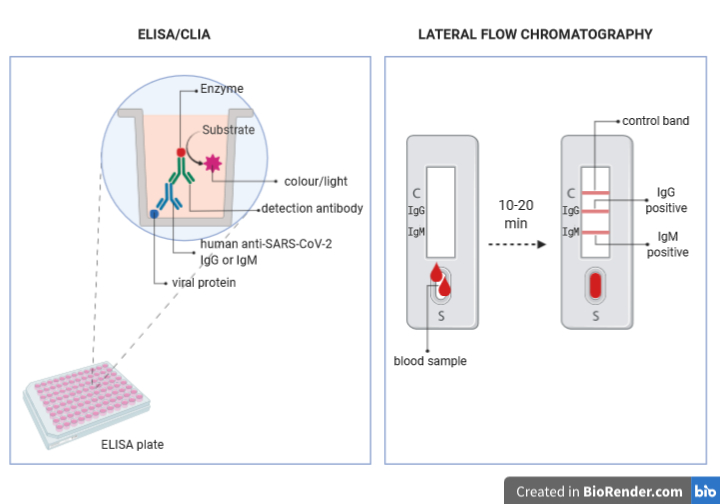
I test sierologici determinano la presenza nel siero (ovvero la parte liquida del sangue che rimane dopo la coagulazione) di specifiche proteine. Nel caso dei test sierologici per COVID-19 si ricercano nel siero gli anticorpi anti-SARS-CoV-2 (anche gli anticorpi sono proteine). L’organismo umano produce 5 tipi di anticorpi diversi (IgA, IgD, IgE, IgG e IgM,Continue reading “Test sierologici per COVID-19: cosa sono e come funzionano”
Serology tests for COVID-19: what they are and how they work
Serology tests detect the presence of specific proteins of interest in the serum (the liquid phase of blood after clotting). Serology tests for COVID-19 aim to detect in the serum specific antibodies against SARS-CoV-2 (antibodies are proteins as well). The human body produces 5 different types of antibodies (IgA, IgD, IgE, IgG e IgM, whereContinue reading “Serology tests for COVID-19: what they are and how they work”
Cosa sappiamo del SARS-CoV-2
“Novel Coronavirus SARS-CoV-2” by NIAID is licensed under CC BY 2.0 (Particelle virali che emergono dalla superficie di una cellula infettata) A dicembre del 2019 abbiamo iniziato a sentir parlare di un nuovo virus che si stava diffondendo in Cina causando un alto numero di casi di polmonite, chiamato temporaneamente 2019-nCoV. L’11 febbraio 2020 ilContinue reading “Cosa sappiamo del SARS-CoV-2”
What we know about SARS-CoV-2
“Novel Coronavirus SARS-CoV-2” by NIAID is licensed under CC BY 2.0 (Virus emerging from the surface of an infected cell) We have heard about a new virus that was causing pneumonia since December 2019; the virus was spreading in China and it was temporarily called 2019-nCoV. On February 11th, 2020, the International Committee on TaxonomyContinue reading “What we know about SARS-CoV-2”
 Virus&Co.