Author’s note: this article was published for the first time on 15/09/2020; latest update: 28/07/2025
What is the West Nile Virus and where is it found?
West Nile Virus (WNV), despite its exotic name, is quite a common virus in Europe. In 2025 cases have been reported in Greece, Romania and Italy.
It was initially present in Africa (when it was isolated for the first time in 1937 in the West Nile region in Uganda), from where it spread to of Europe, the Middle East, Western Asia, and Australia, along the routes of migratory birds.In 1999 the virus arrived in New York and spread to all North America and Venezuela, being now the arbovirus with the widest geographical distribution. The spread of WNV to new areas has been made easier by the unintentional transportation of vector mosquitoes with ships and airplanes, by human activities such as urbanization and field irrigation, and by climate changes (higher temperatures and different precipitation patterns) that have promoted the proliferation of vector mosquitoes.
Does the West Nile virus spread in certain times of the year?
The virus can spread when mosquitoes are active (spring-summer), therefore infections in humans and horses in the Northern hemisphere are mainly reported from July to September.
How does WNV spread?
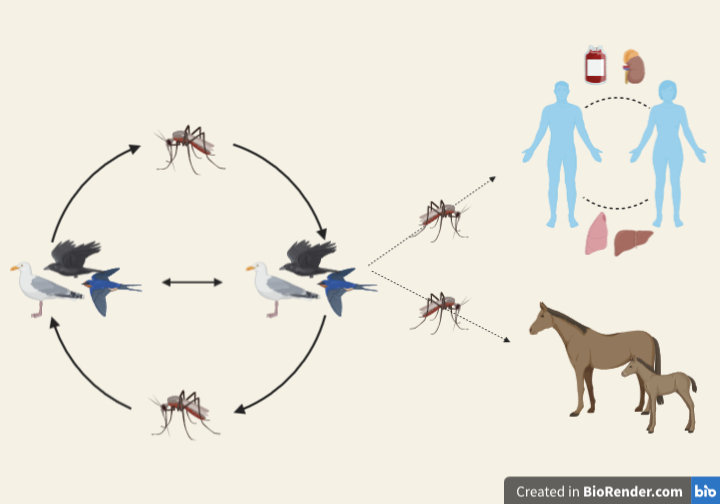
WNV is an arbovirus: a virus transmitted by arthropods (arthropod-borne virus), in particular by the common mosquitoes (Culex pipiens), and it is maintained in nature in a transmission cycle involving mosquitoes (as vectors) and wild birds (as a reservoir). This type of transmission is called enzootic cycle.
The virus is transmitted to wild birds through mosquito bites, and it can occasionally infect humans and horses (more infrequently also other mammals) when they are bitten by a mosquito carrying the virus: it is therefore a zoonotic virus, transmitted from animals to humans. WNV is thought not to cause any disease in insects.
Birds are the specific host and natural reservoir for WNV, supporting an efficient viral replication, while humans and horses are occasional hosts that do not contribute to the spread of the virus, since the number of virual particles in their blood (viremia) remains low. There has been an increase in the infection rate in these two species for the last 20 years.
How do mosquitoes spread WNV?
Mosquitoes acquire the virus through blood meals on infected birds. The virus migrates to the salivary glands and can be later injected into another host where it can replicate and eventually cause disease. To feed on the blood of a vertebrate, mosquitoes inject into the blood vessels of their victims a small quantity of saliva, that, besides avoiding clotting, inhibits the activity of an immune cell type (T cells), allowing the spread of the virus.
Is West Nile Virus contagious?
People infected by WNV are not directly contagious, but the virus can be transmitted to other individuals through blood transfusion or organ transplantation (donors are screened for the presence of WNV –among other viruses- and donation is not allowed within 28 days after arrival from WNV endemic areas). A single case of mother-to-child transmission during pregnancy, as well as a single case of contagion through breastfeeding, have been reported so far.
On the contrary, the virus can be directly transmitted among birds even without vector involvement.
What cells does WNV infect?
Initially, WNV infects the cells of the epidermis (keratinocytes), and some immune cells located in the skin (macrophages and Langerhans cells). While macrophages can rapidly eliminate the virus, infected Langerhans cells migrate to the lymph nodes, from where the virus can spread to other organs and infect a wide range of cell types.
Does WNV cause a disease?
Most of the infections in humans are asymptomatic, but in about 20% of cases, it causes a disease called West Nile Fever (WNF). In less than 1% of cases, WNV leads to the more severe West Nile Neuroinvasive Disease (WNND) when cells of the central nervous system are infected, usually in elderly patients, immunocompromised or affected by other pathologies.
What are the symptoms of WNV infection?
West Nile Fever (WNF) is characterised by the sudden appearance of symptoms such as headache, malaise, muscle soreness, eye pain, nausea, fever, jaundice, and rash. People usually start to feel better in about a week, but sometimes symptoms last for months and require hospitalisation.
West Nile Neuroinvasive Disease (WNND) causes meningitis, encephalitis, flaccid paralysis, or a combination of them, and it leads to death in 17% of cases.
In horses as well, the infection is usually asymptomatic, but in 10% it causes movement disorders, including the inability to stand up, and death.
How can we prevent WNV spread?
Unfortunately, there is no WNV vaccine for humans (but there is one for horses) and to date, there is no specific treatment either.
Nevertheless, the spreading of the virus can be controlled by:
- screening of blood and organ donors
- monitoring of reservoir populations for early detection of the virus in the area
- reduction of standing water areas able to host mosquito larvae
- use of repellents and mosquito nets per reduce exposure to infected adult mosquitoes.
What does WNV look like?
The viral particle is sphere-shaped, with a diameter of about 50 nanometers (= 50 billionths of a meter, or 50 millionths of a millimeter). WNV is an RNA virus belonging to the Flaviviridae family, which includes the Hepatitis C virus (HCV) and Zika virus as well; its genome encodes 10 different proteins and is surrounded by both a proteic capsid and a lipidic envelope.
There are 8 different types of WNV (genotypes), but only genotypes 1 and 2 cause disease in humans.
Bibliography
Habarugira G. West Nile Virus: An Update on Pathobiology, Epidemiology, Diagnostics, Control and “One Health” Implications. Pathogens. 2020. https://www.mdpi.com/2076-0817/9/7/589
Istituto Superiore di Sanità (ISS). Febbre West Nile – News. Epicentro. Accessed 28/07/2025. https://www.epicentro.iss.it/westnile/aggiornamenti
World Health Organisation. West Nile virus. Accessed 28/07/2025. https://www.who.int/news-room/fact-sheets/detail/west-nile-virus
European Centre for Disease Control and Prevention. Factsheet about West Nile virus infection. Accessed 28/07/2025. https://www.ecdc.europa.eu/en/west-nile-fever/facts
European Centre for Disease Control and Prevention. Weekly updates: 2025 West Nile virus transmission season. July 28, 2025. Accessed 28/07/2025. https://www.ecdc.europa.eu/en/west-nile-fever/surveillance-and-disease-data/disease-data-ecdc
 Virus&Co.
Puedes leer este artículo traducido en Castellano aquí: https://www.dciencia.es/que-es-el-virus-del-nilo-occidental/
LikeLike