Il vaccino Oxford-Astra Zeneca: un vaccino basato su un vettore virale

Nel Regno Unito sono stati approvati tre vaccini per contrastare la pandemia: si tratta di due vaccini a mRNA e un vaccino basato su un vettore virale. Quest’ultimo, chiamato AZD1222 è stato sviluppato dall’Università di Oxford e dall’industria biofarmaceutica AstraZeneca.

AZD1222 è basato su un Adenovirus degli scimpanzé, modificato in modo da non potersi replicare dentro le cellule infettate, e che porta al suo interno la sequenza di DNA necessaria per la produzione della proteina Spike di SARS-CoV-2.

È il primo vaccino di questo tipo ad essere approvato, ma la tecnologia era già disponibile e studiata per altri vaccini a partire dai primi anni Duemila.

Inizialmente i vettori basati su Adenovirus vennero sviluppati per essere usati in terapia genica, ovvero per trasferire une versione corretta dei geni mutati nelle cellule di pazienti affetti da malattie genetiche. Ben presto ci si rese conto però che questo tipo di trattamento induceva in molti casi una risposta immunitaria contro il vettore stesso: ciò che costituiva uno svantaggio come vettore per la terapia genica, rendeva gli Adenovirus degli ottimi candidati per essere usati come vaccini. Inoltre gli Adenovirus hanno il vantaggio di causare malattie con sintomi molto lievi (ad esempio il comune “raffreddore” è causato da un Adenovirus), possono infettare diversi tipi di cellule, e sono relativamente stabili, rendendone agevole l’uso clinico.

Gli adenovirus che infettano l’uomo possono causare sia infezioni acute con la presenza di sintomi, che infezioni persistenti nel tempo ma asintomatiche. Alcuni adenovirus sono molto comuni e infettano l’uomo durante l’infanzia. L’abbondanza di adenovirus umani e la frequenza delle infezioni, fa sì che molti di noi (tra il 45% e l’80% della popolazione a seconda dell’area geografica) abbiano un arsenale di anticorpi capaci di riconoscere e neutralizzare gli adenovirus. Per questo motivo per lo sviluppo di vaccini vengono usati o gli Adenovirus umani meno comuni (che infettano il 5-15% della popolazione mondiale) o quelli che infettano altre specie, come gli Adenovirus di scimpanzé.

Gli adenovirus usati come vettori virali vengono modificati geneticamente in modo da:

  • Eliminare i geni che possono causare la malattia
  • Rendere il virus incapace di replicarsi dentro le cellule
  • Rendere il virus incapace di provocare la morte delle cellule
  • Eliminare i geni del virus che normalmente hanno il compito di frenare la risposta antivirale
  • Produrre una proteina del patogeno contro cui si vogliono produrre anticorpi

È importante a questo punto capire che il vaccino non è fatto con un virus di scimpanzé, ma con un vettore geneticamente modificato (virus ricombinante) che mantiene solo le caratteristiche per noi vantaggiose del virus naturale, mentre quelle potenzialmente pericolose o che potrebbero rappresentare uno svantaggio sono state eliminate definitivamente.

Inoltre, il DNA di questi vettori non ha la capacità di integrarsi nel DNA umano, e non può interferire con l’attività di geni umani.

Dopo la vaccinazione, il virus ricombinante entra nelle cellule del sito dell’iniezione e rilascia il suo DNA nel nucleo della cellula. Qui il DNA viene trascritto in RNA, l’RNA lascia il nucleo e viene tradotto per produrre la proteina Spike di SARS-CoV-2. Come tutte le proteine prodotte durante un’infezione virale, anche Spike verrà “digerita” in tanti pezzettini, alcuni dei quali saranno esposti sulla superficie della cellula. Le cellule del sistema immunitario che pattugliano il tessuto vedranno le porzioni di Spike e la riconosceranno come “non umana”. Contemporaneamente, alcune delle particelle virali usate come vaccino, verranno catturate da altri tipi di cellule del sistema immunitario, e portate ai linfonodi. Questi eventi daranno il via alla risposta immunitaria che culminerà, tra le altre cose, con la produzione di anticorpi specifici contro Spike che saranno pronti per attaccare il vero SARS-CoV-2 in caso di infezione.

La vaccinazione con AZD1222 prevede due dosi, con un intervallo tra 4 e 12 settimane. I test clinici hanno dimostrato che:

  1. La seconda dose causa meno effetti secondari rispetto alla prima (meno dolore e gonfiore nel sito dell’iniezione, e meno pazienti hanno riportato febbre, mal di testa, malessere o dolori muscolari)
  2. L’intensità degli eventuali effetti collaterali non ha nessuna correlazione con l’efficacia della vaccinazione
  3. Dopo la prima dose l’organismo produce una certa quantità di anticorpi contro il vettore virale, ma essi non riducono l’efficienza della seconda dose, e non aumentano dopo il richiamo
  4. La vaccinazione induce una quantità di anticorpi anti-Spike superiore a quella osservata in pazienti che sono guariti da COVID-19, misurata tra 28 e 91 giorni dopo la conferma dell’infezione tramite PCR
  5. La quantità di anticorpi prodotti aumenta dopo la seconda dose
  6. Gli anticorpi prodotti in seguito alla vaccinazione sono in grado di compiere diverse funzioni nell’ambito della risposta immunitaria (attivazione della fagocitosi, attivazione del complemento e attivazione delle cellule Natural Killer)
  7. La vaccinazione induce anche una risposta immunitaria mediata dai linfociti T, importante per la risoluzione dell’infezione naturale (una buona risposta cellulare è stata osservata in pazienti con sintomi lievi e guarigione più rapida)
  8. L’efficacia della vaccinazione è del 70.4%: tra i 131 casi di infezione sintomatica che si sono verificati su 11.636 partecipanti che hanno ricevuto la seconda dose, 30 sono stati registrati tra quelli che avevano ricevuto il vaccino (5.807) e 101 tra quelli del gruppo controllo (5.829)
  9. L’efficacia resta la stessa se la seconda dose viene somministrata 4, 6, 8 o 12 settimane dopo la prima dose.

Basandosi su quest’ultimo dato, il governo del Regno Unito ha deciso di usare tutte le dosi al momento disponibili per garantire una prima dose al numero più alto di persone possibile, e di ritardare la somministrazione del richiamo fino a 12 settimane (quando altrettante dosi saranno disponibili); l’obiettivo di questa strategia sarebbe quello di permettere a quante più persone di iniziare a sviluppare una risposta immunitaria nel più breve tempo possibile, data la situazione di emergenza. La seconda dose verrà comunque garantita a tutti entro 12 settimane dalla prima dose.

Alcuni scienziati hanno anche suggerito la possibilità per il futuro di usare diversi tipi di vaccini tra quelli autorizzati per la prima dose e i successivi richiami, in quanto ognuno di essi attiva il sistema immunitario in modo leggermente diverso, e quindi una combinazione potrebbe indurre una risposta immunitaria più completa. Al momento però questa soluzione non è stata ancora adottata.

Immagine: Adenovirus, TEM, di David Gregory & Debbie Marshall, Licenza Creative Commons Attribution (CC BY 4.0), da https://wellcomecollection.org/works/d34rspdt

Bibliografia:

https://www.astrazeneca.com/media-centre/press-releases/2020/astrazenecas-covid-19-vaccine-authorised-in-uk.html

https://www.gov.uk/government/news/oxford-universityastrazeneca-covid-19-vaccine-approved

Replication-defective vector based on a chimpanzee adenovirus, Farina SF et al., Journal of Virology 2001 http://doi.org/10.1128/JVI.75.23.11603-11613.2001

Adenoviruses as Vaccine Vectors, Tatis N et al., Molecular Therapy 2004 http://doi.org/10.1016/j.ymthe.2004.07.013

Phase 1/2 trial of SARS-CoV-2 vaccine ChAdOx1 nCoV-19 with a booster dose induces multifunctional antibody responses, Barrett JR et al., Nature Medicine 2020 https://doi.org/10.1038/s41591-020-01179-4

Safety and efficacy of the ChAdOx1 nCoV-19 vaccine (AZD1222) against SARS-CoV-2: an interim analysis of four randomised controlled trials in Brazil, South Africa, and the UK, Voysey M et al., The Lancet 2020, http://doi.org/10.1016/S0140-6736(20)32661-1
The Oxford-Astra Zeneca vaccine: a viral vector-based vaccine

Three different vaccines have been authorised for emergency use in the United Kingdom to control the pandemic: two of them are mRNA vaccines, and one is based on a viral vector. The latter, called AZD1222, has been developed by Oxford University in collaboration with the biopharma company Astra Zeneca.

AZD1222  is based in a chimpanzee Adenovirus, modified in such a way that it can not replicate inside the infected cells, and it carries the DNA sequence necessary for the production of the Spike protein of SARS-CoV-2.

This is the first vaccine of this type to be approved, but this technology has been available and studied to be used for other vaccines since the early 2000s.

Initially, viral vectors based on Adenoviruses were developed to be used in gene therapy, as shuttles to transfer the correct version of a mutated gene in the cells of patients with genetic diseases. it was soon evident, however, that this kind of treatment in many cases induced an immune response against the vector: what was a disadvantage for a gene therapy vector was a useful characteristic to be exploited as a vaccine platform. Other advantages of the Adenoviruses are that they cause very mild symptoms (for example the common cold is caused by an Adenovirus), they can infect different cell types, and they are relatively stable.

The Adenoviruses that infect humans, cause both acute symptomatic infections and persistent asymptomatic infections. Some of them are very common and infect during childhood. The abundance of human Adenoviruses and the frequency of the infections imply that many of us (45-80% of the population depending on the geographic area) have an armoury of antibodies able to recognize and neutralize them. For these reasons, less common human Adenoviruses (that infect 5-15% of the population) or Adenoviruses that infect other species (eg, chimpanzees), are used for the development of vaccines.

Adenoviruses used as viral vectors are genetically modified in order to

  • Eliminate disease-causing genes
  • Make the virus unable to replicate inside the cells
  • Make the virus unable to kill the cells
  • Eliminate viral genes that inhibit the antiviral defenses of the cells
  • Produce a protein of another pathogen against which we want to produce antibodies

It is very important to understand that the vaccine is not a virus of the chimpanzees, but it is a genetically modified vector (recombinant virus) that maintains only the beneficial characteristics of the natural virus, while those potentially dangerous or disadvantageous have been permanently removed.

Moreover, the DNA of these vectors can not integrate into the human DNA, and can not interfere in any way with the activity of human genes.

Upon vaccination, the recombinant virus enters the cells in the injection site and releases its DNA into their nucleus. There, the DNA is transcribed into RNA, the RNA leaves the nucleus and it is transcribed to produce the Spike protein of SARS-CoV-2. As in any other protein produced during a viral infection, Spike will be digested into small fragments, some of them being exposed on the surface of the cell. The cells of the immune system that patrol the tissue, will see the Spike fragments and will recognize them as “non-human”. At the same time, some viral particles used as a vaccine will be caught by other immune cells and brought to the lymph nodes. All these events will start an immune response, that will culminate, among other things, with the production of specific antibodies against Spike, that will be able to attack the real SARS-CoV-2 in case of infection.

The vaccination strategy with AZD1222 consists of two doses, administered with an interval between 4 and 12 weeks. Clinical trials have shown that:

  1. The second dose causes less and milder secondary effects than the first one (less pain and swelling in the injection site, fewer patients reporting fever, headache, malaise, or muscle ache)
  2. The intensity of the possible secondary effects does not have any correlation with the efficacy of the vaccination
  3. After the first dose, the body produces a certain amount of antibodies against the viral vector, but they  do not impair the efficacy of the second dose and do not increase after the boost
  4. Vaccination induces a higher quantity of anti-Spike antibodies than that observed in patients who recovered from COVID-19, measured between 28 and 91 days after a positive PCR test
  5. The production of antibodies increases after the second dose
  6. The antibodies produced upon vaccination have different functions in the immune response (phagocyte activation, complement activation, Natural Killer cell activation)
  7. The vaccination as well induces a T cell-mediated immune response, important for the resolution of the natural infection (a good cellular response has been observed in patients with mild symptoms and fast recovery)
  8. The efficacy of the vaccination is 70.4%: of 131 cases of symptomatic infections that have occurred among 11.636 participants who received the second dose, 30 have been registered among those who had received the actual vaccine (5.807) and 101 among those in the control group (5.829)
  9. The efficacy does not change when the second dose is administered 4, 6, 8, or 12 weeks after the first dose.

Based on this latest result, the UK government has decided to use all the doses currently available to guarantee the first administration to the highest possible number of people, and to delay the administration of the boost dose up to 12 weeks (when just as many doses will be available). This strategy aims to allow as many people as possible to start mounting an immune response in the shortest time, given the current emergency situation. The second dose will be in any case guaranteed to everybody within 12 weeks.

Some scientists have also suggested the possibility to use different vaccines for the first dose and the boost dose, since every type of vaccine induces a slightly different activation of the immune system, arguing that a combination may induce a more complete immune response. To date, however, this solution has been not yet adopted.

Picture: Adenovirus, TEM, by David Gregory & Debbie Marshall, Creative Commons Attribution (CC BY 4.0) https://wellcomecollection.org/works/d34rspdt

Bibliography:

https://www.astrazeneca.com/media-centre/press-releases/2020/astrazenecas-covid-19-vaccine-authorised-in-uk.html

https://www.gov.uk/government/news/oxford-universityastrazeneca-covid-19-vaccine-approved

Replication-defective vector based on a chimpanzee adenovirus, Farina SF et al., Journal of Virology 2001 http://doi.org/10.1128/JVI.75.23.11603-11613.2001

Adenoviruses as Vaccine Vectors, Tatis N et al., Molecular Therapy 2004 http://doi.org/10.1016/j.ymthe.2004.07.013

Phase 1/2 trial of SARS-CoV-2 vaccine ChAdOx1 nCoV-19 with a booster dose induces multifunctional antibody responses, Barrett JR et al., Nature Medicine 2020 https://doi.org/10.1038/s41591-020-01179-4

Safety and efficacy of the ChAdOx1 nCoV-19 vaccine (AZD1222) against SARS-CoV-2: an interim analysis of four randomised controlled trials in Brazil, South Africa, and the UK, Voysey M et al., The Lancet 2020, http://doi.org/10.1016/S0140-6736(20)32661-1
Un anno di divulgazione scientifica (e che anno!)

Dicembre, tempo di bilanci.

Un anno fa ho deciso di aprire un blog di divulgazione scientifica per raccontare il mio lavoro, per rendere più accessibili le informazioni scientifiche e per combattere la marea di notizie e convinzioni false in cui spesso ci imbattiamo su internet.

Ho scelto di parlare di virus perché è ciò di cui mi occupo in laboratorio da più di sei anni ormai, ma non avrei mai immaginato che questo argomento sarebbe diventato così importante per tutti noi.

La pandemia mi ha trovato in una posizione privilegiata: accesso alle pubblicazioni scientifiche in tempo reale, possibilità di partecipare a seminari e di comunicare con altri scienziati, fino ad essere coinvolta direttamente nelle attività di ricerca.

Fare divulgazione scientifica vuol dire cercare di semplificare al massimo le informazioni, per quanto possibile, per renderle comprensibili a tutti ma mai a scapito della correttezza e del rigore scientifico. E credetemi, non è compito facile!

Ma nel bel mezzo di una pandemia parlare di virus implica una responsabilità in più: quella di filtrare la gran quantità di informazioni che tutti abbiamo ricevuto in questi mesi, riconoscere quelle più attendibili, smentire quelle false cercando di limitarne la diffusione, e seguire costantemente la pubblicazione di nuovi risultati.

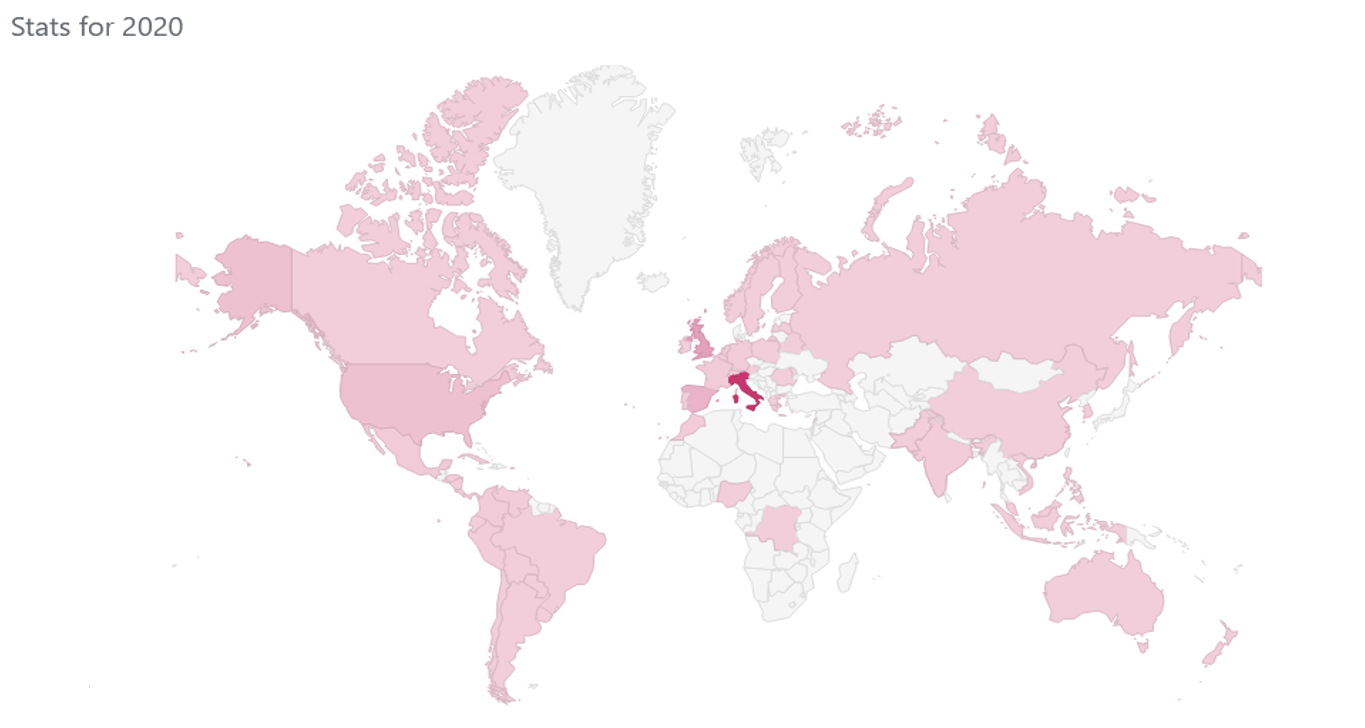
Tutto questo sforzo mi è stato ripagato con la fiducia che mi avete dimostrato ponendomi domande, condividendo e commentando i miei post. Avete fatto in modo che il mio blog venisse letto in tutti i continenti!

Spero che nel 2021 tutta la mappa diventi rosa e che continuiate a farmi domande e a leggere il mio blog, non più per combattere una pandemia, ma solo per curiosità e per la voglia di scoprire cose nuove!

Grazie a tutti,

Carla

Grazie ai miei lettori in giro per il mondo!!

One year of scicomm (and what a year!)

One year ago I decided to start a science communication blog to share with you my job, to make science more accessible, and to fight fake news and false believes that spread on the internet.

I chose to write about viruses because is what I have worked on in the lab for more than six years now, but I never imagined that this topic was bound to become so important for all of us!

The Pandemic found me in a very privileged position, with access to scientific publications in real-time, the possibility to attend seminars and discuss with other scientists, and also being directly involved in the research.

Science communication is about simplifying science as much as possible to make it understandable to everybody, without losing completeness and accuracy. And believe me, it is not easy!

But in a time like this, writing about viruses implies also the greater responsibility of filtering all the information we have been exposed to in these months, recognize the ones that are trustworthy and try to limit the spread of the ones that are not, constantly following the publication of new results.

You have rewarded me with your trust, asking me questions, and sharing and commenting on my posts. You have made it possible for my blog to reach all the continents!

I hope the whole map to become pink in 2021, and that you will keep asking me questions and reading my blog, no longer because there is a pandemic to fight, but just out of curiosity and for the pleasure of discovering something new!

Thank you very much,

Carla

Thank you to all my readers all over the world!!

Studi clinici: regole, fasi e risultati

Prima di essere immessi sul mercato, tutti i farmaci passano attraverso varie fasi di studi preclinici (in laboratorio) e clinici (su volontari).

Nella fase preclinica le molecole vengono testate su modelli come cellule coltivate in laboratorio, e successivamente su modelli di mammiferi più o meno simili all’uomo (dal topolino ai primati, dove permesso dalla legge). La sperimentazione su modelli animali merita un capitolo a parte; in questo post parlerò solo degli studi clinici.

Dopo aver visto che la molecola in questione ha l’effetto desiderato su cellule e modelli animali, è necessario testarla sull’uomo. Nonostante noi umani siamo più simili ai topi di quanto alcuni di noi siano disposti ad ammettere, esistono però delle differenze che, anche se talvolta piccolissime (qualche base azotata qua e là lungo la sequenza di un gene), possono essere determinanti.

Chi autorizza e controlla lo svolgimento di studi clinici? Questo è il compito di enti regolatori come la European Medicine Agency (EMA) nell’Unione Europea, la Food and Drug Administration (FDA) negli Stati Uniti, la Medicines and Healthcare products Regulatory Agency (MHRA) nel Regno Unito. All’interno dell’Unione Europea, i singoli stati hanno le proprie agenzie come l’AIFA (Agenzia Italiana del Farmaco) in Italia.

Chi finanzia gli studi clinici? Il produttore del farmaco fornisce le risorse necessarie per testare il proprio prodotto. Gli studi clinici possono essere sostenuti anche con finanziamenti pubblici o privati (fondazioni, associazioni di pazienti, etc.)

Dove vengono svolti gli studi clinici e chi raccoglie e analizza i dati? Gli studi clinici vengono svolti presso università, centri di ricerca e ospedali da medici e personale scientifico e sanitario autorizzato. Il personale coinvolto negli studi clinici deve possedere una adeguata e certificata formazione.

Durante il disegno di uno studio clinico si decide

  • quante persone, con quali caratteristiche e per quanto tempo parteciperanno
  • quali parametri misurare nei pazienti prima e dopo la somministrazione del farmaco
  • quali effetti collaterali saranno considerati tollerabili
  • in quali circostanze lo studio dovrà essere interrotto.

Viene inoltre redatto un protocollo che descrive minuziosamente tutte le procedure da seguire e come e dove devono essere riportati i dati. Se i dati relativi a un paziente non sono riportati correttamente o se ci sono dei dubbi sull’esecuzione del protocollo, i risultati relativi a quel paziente non saranno considerati validi e non potranno essere analizzati insieme agli altri. Qualsiasi errore o sospetto nella procedura deve essere adeguatamente registrato e fa parte della documentazione dello studio clinico. I protocolli devono essere approvati dagli enti regolatori, i quali svolgono ispezioni a sorpresa nei siti dei test clinici per verificare la correttezza delle procedure.

Le fasi degli studi clinici

Fase I: si valuta la sicurezza e tollerabilità del nuovo farmaco.

Questi test vengono svolti su un numero relativamente piccolo di volontari sani che non hanno né la patologia obiettivo del farmaco, né nessun’altra malattia. Il farmaco viene testato in dosi diverse e vengono registrati effetti collaterali, e come il farmaco viene distribuito e assorbito nei diversi organi.

Se e solo se gli effetti collaterali non superano l’effetto benefico, le agenzie autorizzano la seguente fase. Circa il 70% delle molecole testate supera la fase I.

Fase II: si valuta l’efficacia del nuovo farmaco.

Questi test vengono svolti su volontari affetti dalla patologia che il farmaco intende curare. Le dosi che sono risultate sicure e non tossiche nella fase I vengono somministrate a gruppi di pazienti diversi, e confrontate tra loro e con un placebo (una sostanza che non ha nessun effetto). I volontari non sanno se stanno ricevendo il farmaco attivo o il placebo per evitare qualsiasi suggestione che possa alterare la registrazione di eventuali effetti (sia collaterali che benefici); questa procedura viene detta “singolo cieco”. Nella maggior parte dei casi gli studi vengono svolti in doppio cieco (chi somministra la dose non conosce l’esatto contenuto), o in triplo cieco (chi analizza i dati non sa a quale gruppo appartengano).

Alla fine di questa fase, che dura in genere 2 anni, viene individuata la dose (o le dosi) che danno i migliori risultati con la minima tossicità. Il 33% circa delle molecole passa alla fase successiva.

Fase III: si valuta la superiorità del nuovo farmaco rispetto ad altri già presenti sul mercato.

In questa fase il farmaco viene testato su un numero molto elevato di volontari (migliaia). I volontari vengono suddivisi in modo casuale in gruppi che ricevono il nuovo farmaco, il farmaco (o i farmaci) già approvati per la stessa patologia, o una combinazione di essi. L’obiettivo di questi test è valutare se il nuovo farmaco è efficace quanto o più di quello già esistente e se gli effetti collaterali del nuovo farmaco sono uguali o inferiori. Le condizioni di salute dei volontari vengono osservati per 2-5 anni.

Se gli studi di fase III dimostrano che l’efficacia e la sicurezza del nuovo farmaco sono almeno equivalenti, i produttori del farmaco possono richiedere l’autorizzazione all’immissione sul mercato da parte delle agenzie regolatrici. Ciò accade per il 25-30% dei farmaci che raggiungono la fase III.

Fase IV: vengono studiati gli effetti a lungo termine e le reazione avverse più rare.

Gli studi clinici coinvolgono migliaia di volontari (in alcuni casi anche decine di migliaia) che si stima siano rappresentativi della popolazione mondiale. Talvolta però, è solo durante l’uso di massa di un farmaco che alcuni effetti (quelli più rari) diventano osservabili. Per questo motivo i medici sono tenuti a comunicare tutti gli effetti avversi riportati dai propri pazienti, e le informazioni sulla sicurezza dei farmaci vengono continuamente aggiornate. In caso di effetti collaterali più gravi o più frequenti di quelli previsti durante le prime tre fasi, le agenzie regolatrici possono decidere di sospendere o ritirare l’autorizzazione di un farmaco.

Le fasi degli studi clinici possono essere accorciate o in alcuni casi accorpate se per esempio:

  • si sta studiando un altro effetto di un farmaco già in uso per un’altra malattia (la fase I è già stata eseguita in passato)
  • non esistono farmaci autorizzati per curare la stessa patologia (fase II e III vengono accorpate e svolte su un numero più elevato di volontari).

Anche i vaccini seguono lo stesso iter con una importante differenza: i vaccini vengono somministrati sempre a soggetti sani per prevenire una malattia e non per curarla, quindi gli effetti collaterali considerati accettabili devono essere minimi, l’efficacia deve essere altissima, e il beneficio deve superare ampiamente il rischio.

I dati di tutti i test clinici svolti in Europa sono pubblici e consultabili sul sito www.clinicaltrialsregister.eu; l’equivalente per gli Stati Uniti è clinicaltrials.gov

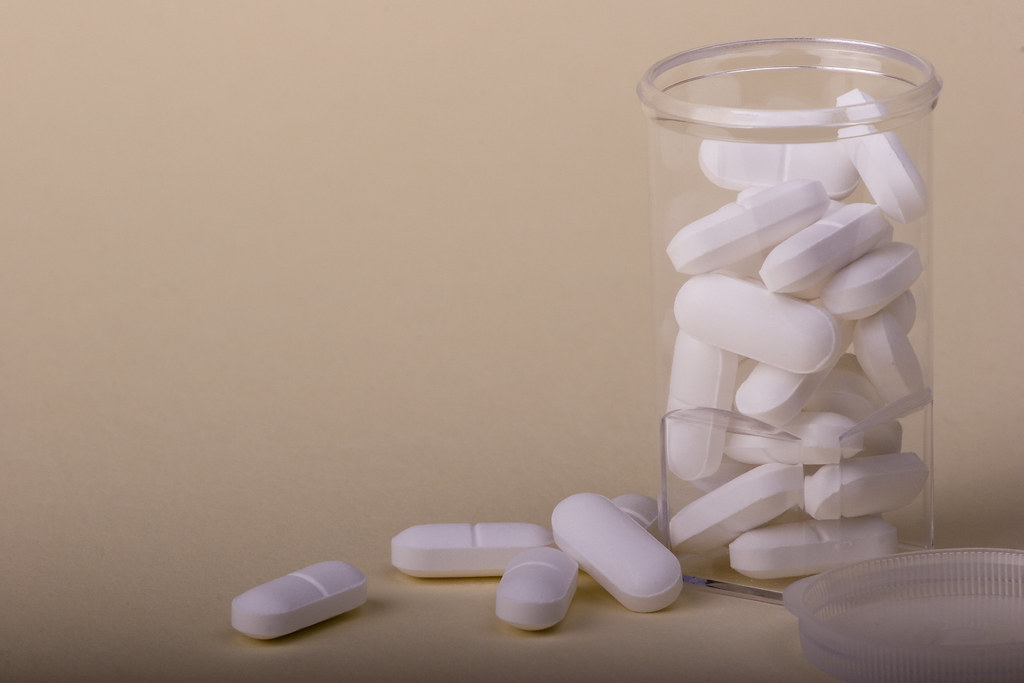
Immagine: “Pills & Container (Landscape)” di Destinys Agent (CC BY-NC 2.0)

Bibliografia

https://www.fda.gov/patients/drug-development-process/step-3-clinical-research

https://www.aifa.gov.it/web/guest/ricerca-e-sperimentazione-clinica

https://www.who.int/health-topics/clinical-trials/#tab=tab_1

Clinical trials: rules, phases, and results

To obtain marketing authorization, all drugs must pass several phases of preclinical (in the lab) and clinical (on human volunteers) trials.

During the preclinical phases, molecules are tested on models such as cells, and animal models more or less similar to humans (from mice to primates, where permitted by the local laws). Experimentation on animal models is a complex topic that deserves a post for its own; in this post, I will discuss clinical trials only.

Once confirmed that the molecule has the desired effects on cells and animal models, it has to be tested on humans in clinical trials. Even if humans are more similar to mice than some of us are would like to admit, there are some differences that, even if most of the times are minimal (some base here and there in the sequence of a gene), may be critical.

Who authorizes and controls clinical trials? This is the task of regulatory agencies like the European Medicine Agency (EMA) in the European Union, the Food and Drug Administration (FDA) in the US, the Medicines and Healthcare products Regulatory Agency (MHRA) in the United Kingdom. Single States within the European Union have their own agency, like AIFA in Italy.

Who pays for clinical trials? Producers provide financial resources to test their own products. Clinical trials can be also supported by grants from public or private funds (foundations, patients associations, etc)

Where are clinical trials conducted and who collects and analyses data? Clinical trials are conducted in universities, research centres, and hospitals by medical doctors and by authorized scientific and healthcare staff. Personnel involved in clinical trials must have adequate and certified training.

During the design of the clinical trial, it is decided

  • how many volunteers will be enrolled, with what characteristics and for how long
  • what parameters must be measured in patients before and after the treatment
  • what adverse effect will be tolerated
  • under what condition the trials will be stopped.

All the procedure details and how and where data must be collected are described in a protocol. If data from a patient are not correctly registered, or if there is any doubt on how the procedure has been carried, the results from that patient will not be considered valid and will not be analysed with the other data. Every error or doubt must be described and will be part of the trial documentation. Protocols have to be approved by the regulatory agencies, who inspect the sites of the clinical trials to verify the accuracy of the procedures.

Phases of clinical trials

Phase I: the safety and tolerability of the new drug are assessed.

These tests are conducted on a relatively small number of healthy volunteers, who have neither the target pathology nor any other disease. The drug is tested in different doses and all the effects are registered, as well as how the drug is distributed and absorbed in the organism. Only if the adverse effects do not overcome the intended beneficial effect, agencies authorize the next phase. About 70% of the new drugs pass phase I.

Phase II: the efficacy of the new drug is tested.

This phase is carried on volunteers with the disease that the new product intends to cure. Doses that resulted to be not toxic in phase I studies are administered to different groups of patients and compared to a placebo (an inactive treatment). Volunteers do not know whether they have received the drug or the placebo to avoid any possible bias in the reported effects (adverse as well as beneficial); this procedure is called single-blind. In most cases, clinical trials are doubleblind studies (the participants and the experimenters do not know which group received the placebo and which received the treatment), and sometimes they are triple-blind (who analyses the data do not know from which group they are).

At the end of this phase, which takes about 2 years, the experimenters identify the dose (or doses) with the best results and the least adverse effects. About 33% of products pass to the following phase.

Phase III: the superiority of the new drug is tested against other products already available.

This phase involves thousands of volunteers, randomly distributed in groups, receiving either the new product or another drug already approved for the same disease, or a combination of them. The aim is to assess whether the new drug is as efficient as or more efficient than the existing one, with the same or fewer adverse effects. Volunteers are monitored for 2-5 years.

If the results of the phase III study demonstrate that the efficacy and safety of the new product are at least equivalent, the producer can apply for marketing authorization. About 25-30% of drugs in phase III is successful.

Phase IV: long-term effects and very rare adverse reactions are monitored

Clinical trials involve thousands of volunteers (sometimes tens of thousands) representative of the global population. Sometimes, however, it is only during the massive use of a drug that some effects (the rarest ones) become visible. This is why medical doctors have to communicate all the adverse effects experienced by their patients, and the safety information of all drugs are continuously updated. In case that the observed adverse effects are more severe or more frequent than during the trials, regulatory agencies can suspend or withdraw marketing authorization.

Sometimes, phases can be shortened or combined, for example, when:

  • a new application of an already approved product is under investigation (phase I was already conducted in the past)
  • there are no authorized drugs for the same disease (phase II and phase III can be combined and conducted on a larger number of volunteers).

Vaccines undergo the same procedure, with one important difference: vaccines are administered in healthy individuals to prevent a disease and not to cure it, therefore acceptable side effects must be minimal, efficacy must be very high, and the beneficial effect must exceed any risk.

Data from clinical trials conducted in Europe are public available at www.clinicaltrialsregister.eu; those conducted in the USA can be found at clinicaltrials.gov

Photo: “Pills & Container (Landscape)” by Destinys Agent is licensed with CC BY-NC 2.0

Bibliography:

https://www.fda.gov/patients/drug-development-process/step-3-clinical-research

https://www.aifa.gov.it/web/guest/ricerca-e-sperimentazione-clinica

https://www.who.int/health-topics/clinical-trials/#tab=tab_1

I vaccini di Pfizer e Moderna: risultati promettenti in tempi record

Dall’inizio della pandemia abbiamo riposto le nostre speranze in un vaccino che potesse liberarci dall’incubo del virus e farci ritornare alla “normalità”, alle abitudini che abbiamo dovuto mettere da parte insieme alla spensieratezza della vita quotidiana.

Già il 16 marzo, pochi giorni dopo la dichiarazione di pandemia da parte dell’Organizzazione Mondiale della Sanità, la compagnia biotecnologia Moderna annunciò l’inizio del primo test clinico di fase 1 per testare la sicurezza del suo vaccino candidato, prevedendo che, in caso di esito positivo, esso sarebbe potuto essere disponibile sul mercato in 12-18 mesi.

Il 16 novembre, la stessa compagnia ha comunicato che i primi risultati del test clinico di fase 3 rivelano un’efficacia del 94.5% dopo due settimane dalla somministrazione della seconda dose del vaccino.

Due giorni dopo, un’altra compagnia farmaceutica, Pfizer, comunicava risultati preliminari del test clinico di fase 3 sul proprio vaccino candidato, riportando un’efficacia del 94% dopo 28 giorni dalla somministrazione della prima dose.

Come funzionano questi vaccini? E come è stato possibile avere i primi risultati in tempi così brevi?

In entrambi i casi si tratta di vaccini a mRNA, che sfruttano una tecnologia diversa e più recente rispetto ai vaccini usati sinora contro altre malattie infettive.

I vaccini “tradizionali” si basano sull’agente patogeno inattivato o attenuato e quindi richiedono che questo venga coltivato e prodotto in grandi quantità, oppure su proteine del microorganismo, o porzioni di esse, che devono essere prodotto e purificate.

Nel caso dei vaccini di Pfizer e Moderna, invece, ciò che viene somministrato è un frammento di RNA che porta con sé le istruzioni per produrre la proteina S di SARS-CoV-2. Dopo l’iniezione, l’RNA viene incorporato dalla cellule che iniziano a produrre la proteina e a presentarla ai linfociti B e T del sistema immunitario.

La proteina S da sola non causa nessuna malattia e non è dannosa per le cellule che la producono; inoltre l’RNA introdotto con il vaccino resta nella cellula per un breve lasso di tempo, e la proteina viene prodotta ed esposta solo temporaneamente, dopo di che sia l’RNA che la proteina S vengono degradate dalla cellula.

Se un individuo vaccinato entra in contatto con il virus SARS-CoV-2, i suoi linfociti riconosceranno immediatamente la proteina S e saranno pronti per attaccare il virus perché sono stati precedentemente istruiti a farlo dal vaccino.

Con questa tecnologia è come se le nostre stesse cellule producessero il vaccino: non c’è bisogno di far produrre la proteina virale a cellule o batteri in coltura e di purificarla, così come non sono necessari i passaggi di coltura, inattivazione e purificazione che fanno parte della produzione di vaccini basati su microorganismi interi.

I passaggi necessari per produrre un vaccino a RNA sono la sintesi della sequenza di nucleotidi (A, U, C, G) con cui sono scritte le istruzioni per la cellula, e la produzione di un involucro lipidico in cui l’RNA viene inserito in modo che per le cellule sia più semplice inglobarlo. È per questo motivo che le due aziende sono state capaci di ridurre così tanto i tempi e di avere i primi risultati sull’efficacia dei loro vaccini in meno di un anno dall’inizio della pandemia.

(Per avere più dettagli su come funzionano i vaccini cliccate qui, se invece volete sapere come si producono le proteine a partire da DNA e RNA cliccate qui).

Immagine: “Doctor writing Covid-19 Vaccine Loading” di focusonmore.com, licenza CC BY 2.0.

Bibliografia

Comunicato stampa di Moderna: https://investors.modernatx.com/news-releases/news-release-details/modernas-covid-19-vaccine-candidate-meets-its-primary-efficacy

Comunicato stampa di Pfeizer: https://www.pfizer.com/news/press-release/press-release-detail/pfizer-and-biontech-conclude-phase-3-study-covid-19-vaccine

Video esplicativo di Moderna su YouTube (in Inglese): https://youtu.be/qJlP91xjvsQ

mRNA vaccines — a new era in vaccinology, Pardi N. et al., Nature Reviews Drug Discovery, 2018, https://doi.org/10.1038/nrd.2017.243

The Moderna and Pfizer vaccines: promising results in less than one year since the beginning of the pandemic

Since the beginning of the pandemic, we have been hoping for a vaccine to defeat the virus and get back to “normality”, a more lighthearted daily life that we had to put aside.

On March 16th, a few days after the WHO had declared the pandemic, the biotech company Moderna announced the beginning of phase 1 clinical trial to test the safety of its vaccine candidate, foreseeing that, in case of positive results, it could be available on the market in 12 to 18 months.

On November 16th, the same company announced that the first results of phase 3 clinical trial showing 94.5% efficacy two weeks after the administration of the second dose.

Two days later, another pharmaceutical company, Pfizer, made public the preliminary results of phase 3 clinical trial for its own vaccine candidate: 94% efficacy 28 days after the administration of the first dose.

How do these two vaccines work? And how has it been possible to have results in such a brief time?

Both Moderna and Pfizer vaccines are based on a more recent technology than the other vaccines available in the market for other infectious diseases: they are mRNA vaccines.

“Conventional” vaccines are based on attenuated or killed pathogens that need to be cultured and produced in large quantities, or are based on proteins, or part of them, that need to be produced and purified.

In this new type of vaccine, however, it is a fragment of RNA that is administered, carrying the instructions to produce the S protein of SARS-CoV-2. After the injection, the RNA is absorbed by the cells that start producing the viral protein and present it to the B and t lymphocytes of the immune system.

The S protein alone does not cause any disease and it is not dangerous for the cells that are producing it; moreover, the RNA of the vaccines stays in the cells for a short time and the S protein is produced only temporarily; then both the RNA and the protein are demolished by the cell itself.

If, after the vaccination, a person is infected by SARS-CoV-2, their lymphocytes will immediately recognize the S protein on its surface and will be ready to attack the virus because the vaccine had already taught them to do so.

With this technology, the cells are somehow producing the vaccine by themselves: there is no need for the production of the viral protein in cells of bacteria and its purification, and, similarly, there is no need to culture the virus, inactivate and purify it as for the vaccines based whole microorganisms.

The steps for the production of an mRNA vaccine are the synthesis of a nucleotide sequence (A, U, C, G) with the instructions for the cell, and the production of a lipidic envelope for the RNA that makes it easier for the cells to absorb it. This why Moderna and Pfizer have been able to reduce the production times and obtain the first results on the efficacy of their vaccines less than one year from the beginning of the pandemic.

(If you want more details on how vaccines work click here, if you want to know how proteins are produced from instructions written on DNA and RNA click here)

Picture: “Doctor writing Covid-19 Vaccine Loading” by focusonmore.com is licensed under CC BY 2.0

Bibliography

Moderna press release: https://investors.modernatx.com/news-releases/news-release-details/modernas-covid-19-vaccine-candidate-meets-its-primary-efficacy

Pfeizer press release: https://www.pfizer.com/news/press-release/press-release-detail/pfizer-and-biontech-conclude-phase-3-study-covid-19-vaccine

Moderna explanatory video on YouTube: https://youtu.be/qJlP91xjvsQ

mRNA vaccines — a new era in vaccinology, Pardi N. et al., Nature Reviews Drug Discovery, 2018, https://doi.org/10.1038/nrd.2017.243

Influenza: tra epidemie stagionali e pandemie

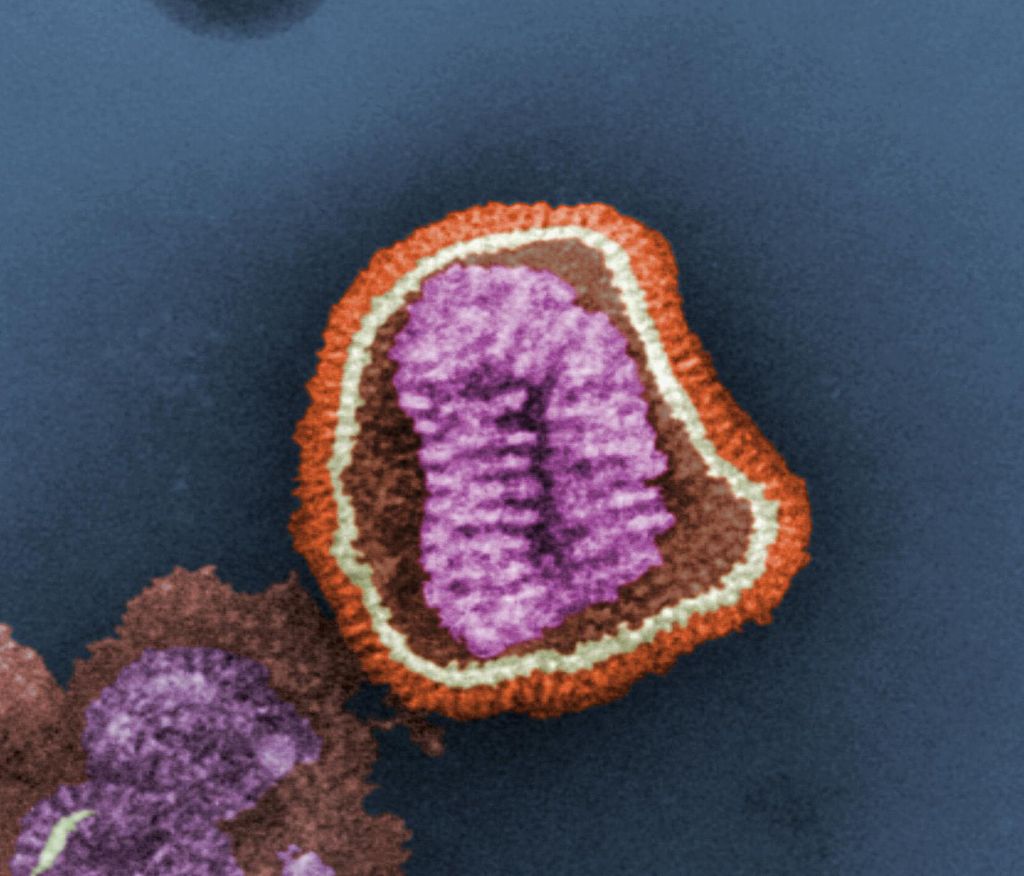
Foto di Cynthia Goldsmith, fornita da CDC/ Dr. Erskine. L. Palmer; Dr. M. L. Martin, Dominio Pubblico, tramite Wikimedia Commons

Nei primi mesi del 2020, quando la diffusione del SARS-CoV-2 era evidente ma ancora non se ne conoscevano le conseguenze, qualcuno cercava di minimizzare la situazione con le parole “è una banale influenza”.

In realtà l’influenza non è banale: è un’infezione virale delle vie respiratorie da cui possiamo proteggerci grazie a un vaccino prodotto ogni anno in base alle caratteristiche dei ceppi in circolazione.

Senza dubbio le epidemie di influenza stagionale oggigiorno non fanno tanta paura come invece accadeva fino alla metà del secolo scorso. Non perché il virus sia meno aggressivo, ma perché le condizioni di vita sono migliorate negli anni fornendoci strumenti più efficienti per contrastare il virus:

  • Migliori condizioni igieniche
  • Disponibilità di vaccini stagionali
  • Disponibilità di farmaci e assistenza medica per i casi più gravi.

Per capire la serietà di questa infezione è necessario conoscere le caratteristiche del virus.

Si tratta di un virus a RNA, di cui si conoscono quattro tipi chiamati A, B, C e D; i primi due sono quelli responsabili delle epidemie annuali, C causa solo lievi sintomi, mentre D sembra non essere in grado di infettare l’uomo.

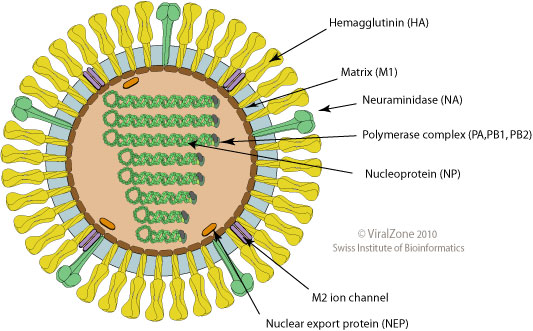
Il virus di tipo A (IAV) è a sua volta suddiviso in sottotipi in base a differenze nelle proteine emoagglutinina (H o HA) e neuroamminidasi (N o NA). Queste proteine sono molto importanti dal nostro punto di vista perché sono esposte sulla superficie del virus, mediano l’ingresso del virus e la diffusione di nuove particele virali dalle cellule infettate e possono essere riconosciute dagli anticorpi. Il virus è dotato di 10 proteine essenziali e di numerose proteine accessorie specifiche dei diversi sottotipi.

Schema di una particella di Influenza Virus di tipo A (immagine presa da http://www.expasy.org/viralzone, SIB Swiss Institute of Bioinformatics)

Il virus dell’influenza è capace di mutare abbastanza rapidamente secondo un fenomeno chiamato deriva antigenica, per cui le difese immunitarie che produciamo dopo la vaccinazione (anticorpi) con molta probabilità non saranno in grado di riconoscere il virus tra un anno. Per questo è consigliato vaccinarsi annualmente e non basta una sola somministrazione nella vita come per altre malattie infettive. Inoltre, il genoma dei virus di tipo A e B è formato da 8 segmenti di RNA, che si possono riassortire tra loro, aumentando la variabilità delle proteine prodotte (spostamento antigenico); ciò è particolarmente importante per la proteina H di IAV. Nessun altro patogeno umano evolve così rapidamente come il virus dell’influenza.

Normalmente più tipi e sottotipi del virus dell’influenza circolano contemporaneamente, e il vaccino annuale è in genere diretto contro due ceppi del tipo A e contro il tipo B.

IAV ha come serbatoio naturale gli uccelli acquatici e può essere trasmesso tra l’uomo e diverse specie animali, come successe nei casi dell’influenza aviaria e suina di cui ho parlato brevemente in questo post, e può potenzialmente causare pandemie come risultato del salto di specie in seguito a riassortimento e spostamento antigenico. Il virus dell’influenza di tipo B (IBV) è invece specifico per gli esseri umani e non infetta altre specie.

Ci sono state 3 pandemie di influenza A nel secolo scorso (1918 – “influenza spagnola”, 1957/58 – “influenza asiatica”, 1968) e una poco più di 10 anni fa, nel 2009. Quest’ultima si originò in Messico e fu rapidamente arginata grazie allo sviluppo tempestivo di un vaccino specifico ed efficace, ma nonostante ciò causò la morte di 200.000 persone (tra cui molti giovani e individui non inclusi nelle categorie solitamente considerate a rischio) rendendo evidente che una pandemia può insorgere in qualsiasi momento e in qualsiasi parte del mondo.

Per quanto riguarda le epidemie stagionali, il 75% delle infezioni sono solitamente asintomatiche.

Negli altri casi l’infezione si manifesta rapidamente con febbre, tosse, malessere, mal di testa e dolori muscolari, e raffreddore. La morte delle cellule infettate indebolisce le mucose delle vie aeree, che diventano così più suscettibili ad altre infezioni. Inoltre l’infiammazione causata dal virus provoca tosse e starnuti che espellono una grande quantità di particelle virali capaci di infettare altre persone.

Quando all’infezione virale si sovrappone un’infezione batterica, la malattia che ne risulta è più grave; la conseguenza più comune è la polmonite, e nei casi più severi anche miocarditi ed encefaliti che possono essere fatali.

Come altre infezioni delle vie respiratorie, il virus dell’influenza viene trasmesso tramite droplets, e il contagio può avvenire anche mediante contatto con oggetti contaminati. Si tratta di un virus altamente contagioso che può diffondersi rapidamente da persona a persona. Per questo le norme igieniche di base sono fondamentali per prevenire l’infezione: lavarsi spesso le mani, coprirsi la bocca quando si tossisce o starnutisce, evitare il contatto con soggetti sintomatici e isolarsi quando si è malati.

Si stima che l’influenza stagionale colpisca ogni anno tra i 2 e i 5 milioni di persone, causando la morte di 250.000-500.000 persone.

Quanto è importante vaccinarsi contro l’influenza stagionale nel contesto della pandemia da SARS-CoV-2? Nella situazione attuale vaccinarsi è ancora più necessario, e i benefici che ne derivano sono sia individuali che collettivi:

  1. Limita la circolazione di IAV e IBV nella popolazione e contribuisce all’immunità di gruppo contro Influenza virus (valido sempre, con o senza SARS-CoV-2)
  2. Evita la doppia infezione che potrebbe causare una malattia con sintomi molto gravi e conseguenze che al momento non conosciamo
  3. Facilita la diagnosi di COVD-19: i sintomi iniziali sono simili per entrambe le infezioni, se si è vaccinati contro l’influenza si può escludere con alta probabilità questa infezione
  4. Evita la saturazione degli ospedali dovuta ai casi gravi di influenza, garantendo posti letto e assistenza per i casi di COVID-19.

(Per saperne di più su come funzionano i vaccini cliccate qui)

Bibliografia

Influenza A Virus Cell Entry, Replication, Virion Assembly and Movement,Dou D. et al., Frontiers in Immunology 2018, https://doi.org/10.3389/fimmu.2018.01581

Novel Influenza D virus: Epidemiology, pathology, evolution and biological characteristics, Shuo Su et al., Virulence 2017 https://doi.org/10.1080/21505594.2017.1365216

Two Years after Pandemic Influenza A/2009/H1N1: What Have We Learned?, Cheng V. et al., Clinical Microbiology Reviews 2012, https://doi:10.1128/CMR.05012-11

Centro Europeo per la Prevenzione e il Controllo delle Malattie https://www.ecdc.europa.eu/en/seasonal-influenza/facts/factsheet

Centro per il Controllo e la prevenzione delle Malattie (USA) https://www.cdc.gov/flu/pandemic-resources/index.htm

Oragnizzazione Mondiale della Sanità https://www.who.int/influenza/en/

The flu: seasonal outbreaks and pandemics

At the beginning of 2020, when the spread of SARS-CoV-2 was undeniable but its consequences were still unknown, some tried to minimize the situation, saying that it was “just like a flu”.

However, the flu is not an insignificant disease: it is a viral infection of the airways that we can prevent with a vaccine produced every year based on the characteristics of the circulating strains.

Nowadays, the perception of seasonal flu outbreaks is less frightening than in the past, not because the virus is less aggressive, but because our living conditions have improved since the second half of the last century, giving us tools to contain the virus:

  • Better standards of hygiene
  • Availability of seasonal vaccines
  • Availability of medicines and medical care for the most severe cases.

To really understand the relevance of this infection, an understanding of the characteristics of the virus is necessary.

It is an RNA virus, classified into 4 different types: A and B are responsible for the seasonal epidemics, C causes only mild symptoms, while D is not known to infect humans.

Type A virus (IAV) has several subtypes that present with different versions of the proteins haemagglutinin (H) and neuraminidase (N). These two proteins are very important from the human point of view, because they are displayed on the surface of the virus, mediate the entry and the release of new viral particles from infected cells, and can be recognized by antibodies. The virus has 10 essential proteins and several accessory proteins that are subtype-specific.

Diagram of a Influenza A virus particle (taken from http://www.expasy.org/viralzone, SIB Swiss Institute of Bioinformatics)

Influenza virus can rapidly mutate according to a phenomenon called antigenic drift, so that the antibodies induced by the vaccination, will not probably recognize the virus one year later. This is why, unlike other infectious diseases, one single vaccine is not enough, and yearly vaccination is recommended. Moreover, the genome of type A and B viruses consists of 8 RNA fragments, that can undergo rearrangement, increasing the variability of the viral proteins (antigenic shift); this is particularly important for protein H of IAV. No other human pathogen can evolve as quickly as Influenza virus.

Usually, several types and subtypes of Influenza virus circulate among the population at any time, and the annual vaccine normally targets two strains of type A and type B.

Aquatic birds are the natural reservoir for IAV, and it can be spread between human beings and other animals, as in the case of avian flu and swine flu (which I briefly mentioned in this post), potentially causing pandemics as a result of the host shift after rearrangement and antigenic shift. On the other hand, Influenza virus type B (IBV) only infects humans.

There were 3 IAV pandemics during the last century (1918 – “Spanish flu”, 1957/58 – “Asiatic flu”, 1968) and another one only 11 years ago, in 2009. The latter started in Mexico and was rapidly contained thanks to the prompt development of an efficient specific vaccine, nonetheless, it caused the death of about 200.000 people (mostly young or not included in the classical risk groups), highlighting that a pandemic may start at any moment in any place.

During seasonal outbreaks, 75% of infections are usually asymptomatic.

In other cases, rapid onset of symptoms is observed, including fever, cough, malaise, headache, myalgia, and runny nose. The death of infected cells weakens the airway mucosa, turning them more prone to other infections. Moreover, the inflammation caused by the virus induces cough and sneezes that expel a huge number of viral particles able to infect other people.

When a bacterial infection occurs on a flu-infected patient, the resulting disease is more severe; the most common consequence is pneumonia or fatal myocarditis and encephalitis in the most severe cases.

Like other infections of the airways, Influenza virus spreads through droplets, and it can also be transmitted by contact with contaminated objects. It is a very contagious virus that can spread rapidly from person to person. This is why basic hygiene rules are essential for prevention: wash your hands, cover your mouth when you cough or sneeze, avoid contact with symptomatic patients, and self-isolate if ill.

Seasonal flu affects about 2-5 million people every year, causing 250.000-500.000 deaths.

How is important the get vaccinated against seasonal flu in the context of the SARS-CoV-2 pandemic? Due to the current situation, getting vaccinated is more important than ever, with positive effects both for the individuals and the community:

  1. It limits the spread of IAV and IBV in the population, contributing to herd immunity against Influenza virus (always true, with or without SARS-CoV-2)
  2. It avoids double infections that can cause severe disease with still unknown consequences
  3. It helps the diagnosis of COVD-19: since the early symptoms are similar for both infections, being vaccinated against seasonal flu allows to rule out this possibility
  4. It prevents the saturation of hospitals due to severe cases of flu, ensuring beds and medical assistance for COVID-19 patients.

(To know more about how vaccines work click here)

Photo Credit: Cynthia GoldsmithContent Providers(s): CDC/ Dr. Erskine. L. Palmer; Dr. M. L. Martin, Public domain, via Wikimedia Commons

Bibliography

Influenza A Virus Cell Entry, Replication, Virion Assembly and Movement,Dou D. et al., Frontiers in Immunology 2018, https://doi.org/10.3389/fimmu.2018.01581

Novel Influenza D virus: Epidemiology, pathology, evolution and biological characteristics, Shuo Su et al., Virulence 2017 https://doi.org/10.1080/21505594.2017.1365216

Two Years after Pandemic Influenza A/2009/H1N1: What Have We Learned?, Cheng V. et al., Clinical Microbiology Reviews 2012, https://doi:10.1128/CMR.05012-11

European Centre for Disease Prevention and Control: https://www.ecdc.europa.eu/en/seasonal-influenza/facts/factsheet

Centers for Disease Control and Prevention: https://www.cdc.gov/flu/pandemic-resources/index.htm

World Health Organization: https://www.who.int/influenza/en/

Design a site like this with WordPress.com
Get started